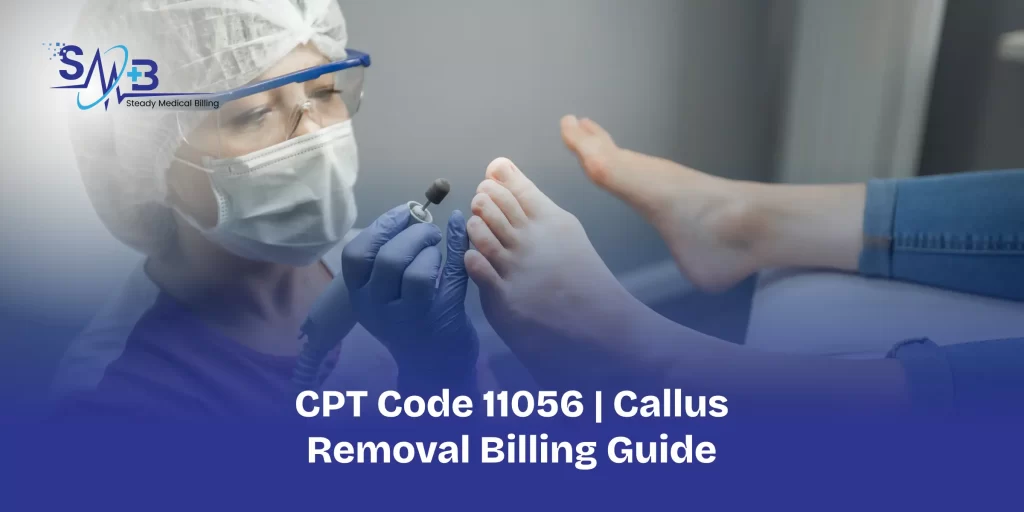
For many podiatry and primary care providers, coding correctly for callus and corn removal is not as simple as it looks. While patients often see this as routine foot care, payers classify it differently — only reimbursing when it meets medical necessity guidelines. That’s where CPT Code 11056 becomes vital.
This blog will give you a complete breakdown of CPT 11056: its description, clinical use, billing rules, modifier use, common denial reasons, and compliance best practices. By the end, you’ll know how to code confidently, avoid unnecessary denials, and ensure your practice gets reimbursed for services that protect patient health.
What Is CPT Code 11056?
CPT Code 11056 is used to report the paring or cutting of benign hyperkeratotic lesions (corns and calluses), when 2 to 4 lesions are treated during the same session.
Key points:
- Covers therapeutic removal, not cosmetic or routine care.
- Applicable to 2–4 corns or calluses in one visit.
- Must be performed by a qualified healthcare professional.
- Documentation must show medical necessity, often tied to systemic disease.
Related Codes for Lesion Count
- 11055 → Removal of a single corn or callus.
- 11056 → Removal of 2–4 corns or calluses.
- 11057 → Removal of 5 or more corns or calluses.
Correctly selecting between these ensures accurate billing and prevents payer audits.
11056 CPT Code Description and Clinical Scope
The official CPT description states:
“Paring or cutting of benign hyperkeratotic lesion (e.g., corn or callus); 2 to 4 lesions.”
When Is 11056 Used?
Providers should use 11056 when:
- Corns or calluses cause pain, impaired mobility, or risk of ulceration.
- Lesions are associated with diabetes, neuropathy, or vascular compromise.
- Conservative care has failed, and intervention is clinically necessary.
- Documentation clearly links the service to an underlying condition.
Common Clinical Scenarios
- A diabetic patient with painful calluses under the metatarsal heads.
- A vascular disease patient with corns that increase risk of ulceration.
- Neuropathic patients with recurrent calluses requiring periodic paring.
Using 11056 outside these medical necessity scenarios often results in denials.
Why CPT 11056 Is Not Routine Foot Care
Many denials happen because payers classify corns and calluses as “routine foot care,” which is non-reimbursable unless certain criteria are met.
Key Differences
- Routine care: Trimming nails, cosmetic callus smoothing, preventive services.
- Medically necessary 11056: Lesions treated due to systemic disease, pain, infection risk, or impaired ambulation.
Providers must document:
- Patient’s diagnosis (ICD-10 linked to diabetes, neuropathy, or vascular disease).
- The number of lesions treated (2–4).
- Clinical notes proving necessity (pain, risk, or impaired function).
Without this, payers will deny claims under “non-covered services.”
Common ICD-10 Codes Linked to 11056
To support medical necessity, CPT 11056 claims should include diagnosis codes that align with systemic disease or complications. Examples include:
- E11.40 – Type 2 diabetes with neuropathy
- E11.51 – Type 2 diabetes with peripheral angiopathy
- I70.213 – Atherosclerosis of native arteries of legs
- M79.671 – Pain in right foot
- M79.672 – Pain in left foot
Using nonspecific codes like “L84 – Corns and callosities” alone is rarely enough unless paired with a systemic condition.
How to Bill CPT Code 11056 Correctly
Step 1: Count Lesions Precisely
- 1 lesion → 11055
- 2–4 lesions → 11056
- 5+ lesions → 11057
Step 2: Document Thoroughly
- Number and location of lesions.
- Diagnosis supporting medical necessity.
- Patient symptoms or risks (pain, mobility issues, infection).
Step 3: Pair With Proper Diagnosis
- Always link ICD-10 codes tied to systemic disease or complications.
Step 4: Use Modifiers When Needed
- Modifier 25: If performed with an E/M service on the same day.
- Modifier 59: If multiple procedures were done and need separation.
Reimbursement for CPT 11056
Reimbursement rates vary by payer and region, but on average:
- Medicare: $50–$70 per session
- Commercial insurance: $55–$90 depending on contract
- Medicaid: Often lower, typically $35–$60
Tips to Maximize Reimbursement
- Always include NPI of the rendering provider.
- Verify local coverage determinations (LCDs) in your MAC region.
- Include NDC/J-codes if topical drugs were administered.
Common Denial Reasons for CPT Code 11056
Even when coded correctly, denials are frequent. Here are the top causes:
- Non-covered routine foot care → Payers deny if systemic disease not documented.
- Diagnosis mismatch → ICD-10 code doesn’t justify medical necessity.
- Lesion count not specified → Missing documentation of “2–4 lesions.”
- Bundling with E/M → Not using modifier 25 when appropriate.
- Frequency limitations → Payers limit to every 60 or 90 days.
How to Avoid Them
- Check payer-specific frequency policies.
- Document lesion count in every note.
- Use clear ICD-10 support beyond “corns and calluses.”
- Appeal denials with chart notes and photos if possible.
Difference Between CPT 11055, 11056, and 11057
| Code | Description | When Used |
| 11055 | Paring/cutting of 1 lesion | For a single corn/callus |
| 11056 | Paring/cutting of 2–4 lesions | For multiple but <5 lesions |
| 11057 | Paring/cutting of 5+ lesions | For extensive lesions in one visit |
This makes 11056 the most commonly used code in podiatry practices, especially for diabetic patients.
Compliance Tips for CPT 11056
To stay compliant and audit-ready, follow these steps:
- Always link callus removal to medical necessity.
- Ensure EHR templates capture lesion count.
- Use photographs or diagrams in patient charts when appropriate.
- Keep track of frequency limits by payer.
- Train billing staff on differences between 11055, 11056, 11057.
Future Trends in Billing for Callus Removal
As payers become stricter, expect changes that will affect 11056 billing:
- More LCD audits → Medicare already flags routine foot care closely.
- Increased documentation demands → Expect payers to request chart notes more frequently.
- Frequency restrictions tightening → Especially for diabetic patients receiving regular callus care.
- EHR automation → Smart systems will auto-flag missing lesion counts or mismatched ICDs.
Practices that prepare for these trends will avoid denials and protect revenue.
Final Thoughts
At first glance, CPT Code 11056 seems simple — just callus removal. But in billing terms, it is one of the most frequently denied podiatry services. The difference between reimbursement and rejection often comes down to documentation: showing that lesions were more than cosmetic, linking them to systemic conditions, and proving medical necessity.
By following payer rules, documenting carefully, and coding with precision, providers can minimize denials and maximize reimbursement. In podiatry, where margins are thin, even small improvements in coding accuracy for CPT 11056 can make a big financial difference.
If your practice struggles with rejections for 11056 or other podiatry billing codes, specialized billing support may be the most effective way to protect your revenue cycle.