Leukocytosis is one of the most common findings in clinical medicine. For coders and billers, it often creates confusion because providers document it differently, payers deny claims if the coding is vague, and ICD-10 rules continue to evolve each October.
This guide explains ICD-10 coding for leukocytosis (D72.829), gives documentation checklists, shows how to avoid denials, and provides real case-based examples. It is designed for coders, clinicians, and billing teams who want clean claims, fewer rejections, and compliant reporting.
What is Leukocytosis?
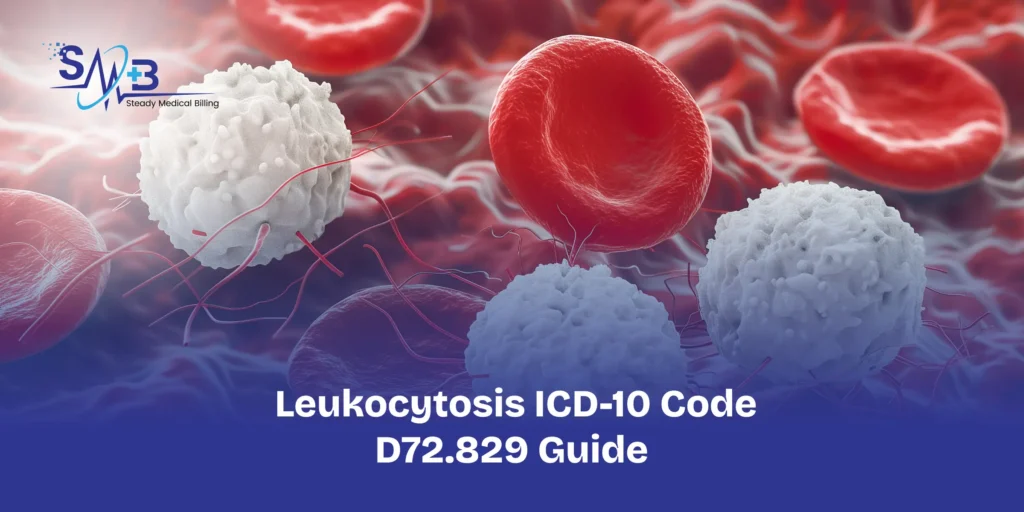
Leukocytosis is the medical term for an elevated white blood cell count (WBC) that exceeds the normal range. White blood cells are essential for immune defense, so when the body detects infection, inflammation, or other stress, the count often rises. This increase shows up during routine blood work and alerts clinicians to investigate further.
- Adults: Leukocytosis is usually defined as a WBC count greater than 11,000 cells per microliter of blood.
- Children: Normal values vary by age, so pediatric leukocytosis must always be interpreted using age-specific reference ranges.
Leukocytosis is not a disease on its own but rather a laboratory finding that points toward underlying causes. These can include:
- Infections: bacterial, viral, or fungal.
- Inflammation: chronic conditions like arthritis.
- Stress: physical strain, trauma, or emotional stress.
- Medications: corticosteroids and other drugs.
- Hematologic conditions: including leukemia and bone marrow disorders.
Because the list of potential causes is so broad, leukocytosis always requires clinical context. A high WBC count might be harmless in one scenario, yet in another it could signal a serious condition that needs urgent attention.
ICD-10 Code for Leukocytosis
Leukocytosis is coded in ICD-10 as D72.829, a billable code used when the provider documents leukocytosis without specifying the exact type of white blood cell.
Key Details
- Code: D72.829
- Description: Leukocytosis, unspecified
- Chapter: Diseases of the blood and blood-forming organs (D50–D89)
- Billable: Yes, valid for reimbursement
- Effective Date: October 1, 2018 (still current)
This ICD-10 code is applied when the documentation mentions leukocytosis but lacks further detail, ensuring the claim remains accurate and eligible for proper reimbursement.
Related Codes for Leukocytosis
| Code | Description | When to Use |
| D72.829 | Leukocytosis, unspecified | General leukocytosis without subtype documented |
| D72.821 | Leukemoid reaction | Provider specifies leukemoid reaction |
| D72.820 | Neutrophilia | Documented increase in neutrophils |
| D72.8201 | Lymphocytosis | Documented increase in lymphocytes |
| D72.8202 | Eosinophilia | Documented increase in eosinophils |
| D72.8203 | Basophilia | Documented increase in basophils |
When to Use D72.829 vs More Specific Codes
D72.829 should be used only when the provider does not specify the cell type. If the documentation provides more detail, use the more specific ICD-10 code.
Decision guide for coders:
- If the provider writes “leukocytosis” only → D72.829
- If the provider specifies:
- Neutrophilia → D72.820
- Lymphocytosis → D72.820 with appropriate extension
- Eosinophilia → D72.820 (different sub-code)
- Basophilia → D72.820
- If the cause is clear (infection, sepsis) → code underlying condition plus leukocytosis if clinically significant.
Excludes Notes and Related Conditions
ICD-10 coding guidance requires careful attention to Excludes1 and Excludes2 notes.
- Excludes1: Do not code leukocytosis with leukemoid reaction (D72.821) or with other specified WBC abnormalities when they are documented.
- Excludes2: Leukocytosis can be coded with conditions like pneumonia, urinary tract infection, or appendicitis if both are significant and treated.
Documentation Checklist for Providers
To ensure clean claims, documentation must support the diagnosis. Minimum requirements include:
- Lab evidence: CBC report with WBC count.
- Specific type: Neutrophilia, lymphocytosis, eosinophilia, etc., if known.
- Associated condition: Infection, medication effect, inflammation, or “unspecified.”
- Management plan: Workup, repeat labs, or treatment.
Examples:
- “Leukocytosis secondary to pneumonia.”
- “Leukocytosis, steroid-induced.”
- “Leukocytosis, unspecified type.”
Common Denial Reasons and Fixes
Denials related to leukocytosis ICD-10 coding are frequent. Here are the common reasons and preventive steps:
- “Leukocytosis is a symptom, not a diagnosis.”
- Pair with primary condition if present.
- Pair with primary condition if present.
- “Code too vague, needs specificity.”
- Query provider for cell type when available.
- Query provider for cell type when available.
- “Duplicate diagnosis, not separately payable.”
- Use only when leukocytosis is clinically addressed in the record.
- Use only when leukocytosis is clinically addressed in the record.
- “Documentation does not support ICD-10 code.”
- Always include lab results and provider statement.
- Always include lab results and provider statement.
Clinical Scenarios and Coding Examples
Case 1: Outpatient UTI with leukocytosis
- Documentation: “Patient with fever, UTI, leukocytosis noted on CBC.”
- Coding: N39.0 (UTI), D72.829 (leukocytosis).
Case 2: Inpatient pneumonia with leukocytosis
- Documentation: “Admitted for pneumonia, labs reveal leukocytosis, treated with antibiotics.”
- Coding: J18.9 (pneumonia), D72.829 (leukocytosis).
Case 3: Oncology follow-up with steroid-related leukocytosis
- Documentation: “Leukocytosis likely due to prednisone therapy.”
- Coding: T38.0X5A (adverse effect of steroids), D72.829 (leukocytosis).
Annual Updates to Monitor
ICD-10-CM updates go live each year on October 1.
For leukocytosis codes, always:
- Check if new sub-codes are introduced.
- Verify Excludes note changes.
- Confirm billable status of D72.829.
- Update coding cheat sheets and provider education.
Why Accurate Coding Matters
Accurate coding of leukocytosis is critical for:
- Reimbursement: Prevents claim denials.
- Clinical accuracy: Tracks abnormal lab results.
- Compliance: Reduces audit risk.
- Data reporting: Supports research and quality metrics.
Quick Reference Table
| Code | Description | When to Use |
| D72.829 | Leukocytosis, unspecified | Provider documents “leukocytosis” only |
| D72.821 | Leukemoid reaction | Provider specifies leukemoid reaction |
| D72.820x | Neutrophilia, lymphocytosis, eosinophilia, basophilia | Provider specifies subtype |
Conclusion
Leukocytosis is a common finding but coding it incorrectly can lead to denials and compliance issues. Use D72.829 only when there is no additional detail available. Always check Excludes notes, document lab results, and link leukocytosis with the underlying cause when appropriate.
Clear documentation and accurate coding improve reimbursement, compliance, and patient record integrity. Make this guide part of your daily coding workflow.