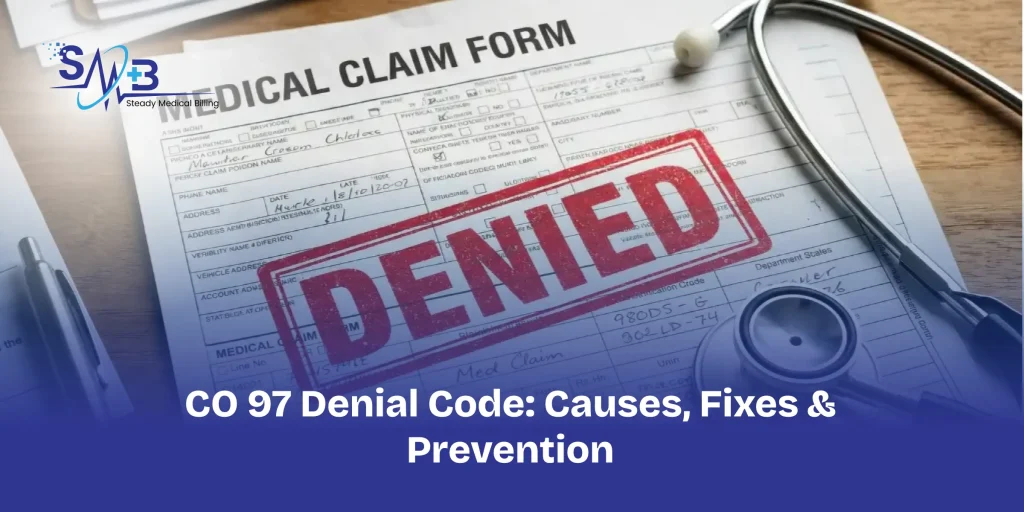
In medical billing, claim denials can significantly disrupt cash flow, increase administrative workload, and delay reimbursements. One of the most common and misunderstood denial codes is the CO 97 denial code.
Healthcare providers often encounter CO 97 denials when services are considered bundled, included in another procedure, or not separately reimbursable under payer rules. While this denial may seem straightforward, resolving it requires a strong understanding of coding guidelines, National Correct Coding Initiative (NCCI) edits, modifiers, and payer-specific billing policies.
In this comprehensive guide, Steady Medical Billing explains:
- what the CO 97 denial code means
- why it occurs
- common examples
- how to fix it
- when to appeal
- how to prevent future denials
Understanding denial code CO 97 is essential for improving claim accuracy, reducing revenue leakage, and strengthening your revenue cycle management process.
What Is CO 97 Denial Code?
The CO 97 denial code means:
The billed service is included in the payment for another procedure or service and is not separately reimbursable.
In simple terms, the insurance payer believes the denied procedure is already covered under another billed service, surgical package, or bundled payment.
The “CO” in CO 97 stands for:
- Contractual Obligation
This means the adjustment is based on payer contract rules, and in most cases, the patient is not financially responsible for the denied amount.
Why CO 97 Denials Matter in Medical Billing
Many healthcare organizations underestimate the financial impact of CO 97 denials.
These denials can lead to:
- delayed reimbursements
- increased accounts receivable (AR)
- claim rework costs
- staff productivity loss
- compliance risks
- reduced first-pass claim acceptance rates
Repeated CO 97 denials may also indicate larger coding workflow problems within a practice.
For medical practices processing high claim volumes, even small denial percentages can result in significant revenue leakage over time.
What Causes CO 97 Denials?
Several coding and billing scenarios can trigger a CO 97 denial.
1. Bundled Procedures
Certain CPT codes are considered inclusive of another procedure and cannot be billed separately.
Example:
- Blood specimen collection billed separately during a routine encounter
The payer considers the specimen collection included in the primary service.
2. NCCI Edits
The National Correct Coding Initiative (NCCI) identifies procedure combinations that should not be billed together.
These edits prevent:
- unbundling
- duplicate billing
- improper coding
If mutually exclusive procedures are billed together, the claim may trigger a CO 97 denial.
3. Incorrect Modifier Usage
Missing or incorrect modifiers are a major cause of CO 97 denials.
For example:
- failure to append Modifier 59
- incorrect use of Modifier 25
- misuse of Modifier XE, XS, XP, or XU
Without proper modifiers, payers assume services are bundled.
4. Services Within Global Surgical Periods
Evaluation and Management (E/M) services provided during postoperative global periods are often included in the surgical package.
Typical global periods:
- Minor surgery: 10 days
- Major surgery: 90 days
Billing separately for included postoperative services may trigger denial code 97.
5. Duplicate Billing
Submitting the same procedure multiple times for the same date of service can result in CO 97 denials.
6. Inclusive Laboratory or Ancillary Services
Some laboratory handling fees, specimen transportation, and ancillary services are already included in reimbursement schedules.
Common Examples of CO 97 Denials
Example 1: Postoperative E/M Visit
A surgeon performs a procedure and bills a postoperative office visit during the global period.
Result:
- The office visit is denied under CO 97 because it is bundled into the surgical package.
Example 2: Modifier 59 Missing
A provider performs two distinct procedures on the same day but fails to append Modifier 59.
Result:
- One procedure is denied as bundled.
Example 3: Duplicate CPT Submission
The billing department accidentally submits the same CPT code twice.
Result:
- One claim line is denied under CO 97.
Example 4: Bundled Lab Services
A clinic separately bills specimen handling already included in laboratory reimbursement.
Result:
- Separate reimbursement is denied.
Understanding NCCI Edits and CO 97 Denials
The National Correct Coding Initiative (NCCI) was developed by CMS to reduce improper coding and prevent unbundling.
NCCI edits identify:
- mutually exclusive procedures
- bundled services
- improper CPT combinations
Two Important NCCI Concepts
Column 1 Codes
Primary procedures that are reimbursable.
Column 2 Codes
Services considered incidental or bundled into Column 1 procedures.
If both are billed together without an appropriate modifier, payers may deny the Column 2 code under CO 97.
Modifier 59 and CO 97 Denials
Modifier 59 is one of the most important tools for preventing inappropriate bundling denials.
What Is Modifier 59?
Modifier 59 indicates:
A distinct procedural service performed separately from another procedure on the same day.
It may be used when procedures involve:
- different anatomical sites
- different encounters
- separate incisions
- separate injuries
When to Use Modifier 59
Use Modifier 59 only when:
- documentation supports distinct services
- procedures are not normally bundled
- services were independently necessary
When NOT to Use Modifier 59
Improper use may trigger:
- audits
- compliance reviews
- payer scrutiny
- fraud concerns
Never use Modifier 59 simply to bypass denials.
X Modifiers and CO 97 Denials
CMS introduced X modifiers for greater specificity:
| Modifier | Meaning |
| XE | Separate encounter |
| XS | Separate structure |
| XP | Separate practitioner |
| XU | Unusual non-overlapping service |
These modifiers may help support separate reimbursement when appropriate.
Common CARC Codes Associated With CO 97
Additional Claim Adjustment Reason Codes (CARCs) often accompany CO 97 denials.
| CARC Code | Meaning |
| N120 | Included in E/M service |
| N372 | Included in another procedure |
| N770 | Bundled into another payment |
Understanding CARCs helps billing teams identify the exact denial reason faster.
Step-by-Step Process to Resolve CO 97 Denials
Step 1: Review the ERA or EOB
Carefully review:
- denied CPT codes
- CARC codes
- payer remarks
- adjustment explanations
Step 2: Check NCCI Edits
Verify whether the billed procedures are:
- bundled
- mutually exclusive
- globally included
Step 3: Review Modifiers
Determine whether:
- Modifier 59 was omitted
- another modifier applies
- modifier documentation supports separate billing
Step 4: Validate Documentation
Review operative notes and clinical documentation to confirm:
- distinct services
- medical necessity
- separate encounters
Step 5: Correct and Resubmit the Claim
If coding errors are identified:
- update CPT coding
- append proper modifiers
- resubmit corrected claims
Step 6: Appeal When Appropriate
If the denial is incorrect:
- submit supporting documentation
- include coding rationale
- reference payer guidelines
- explain modifier usage
Step 7: Monitor Denial Trends
Track:
- denial frequency
- payer patterns
- provider-specific trends
- coding error categories
This helps reduce future denials.
When Should You Appeal a CO 97 Denial?
Appeals are appropriate when:
- modifiers were correctly used
- services were truly separate
- documentation supports medical necessity
- payer processing errors occurred
Do not appeal when services are legitimately bundled under CMS or payer guidelines.
Specialty-Specific CO 97 Denial Examples
Orthopedic Surgery: Postoperative follow-up visits billed during global periods frequently trigger CO 97 denials.
Cardiology: Diagnostic procedures performed with bundled interpretation services may deny separately.
Urgent Care: Multiple E/M services on the same date often require modifier review.
Radiology: Imaging guidance services may already be included in procedural reimbursement.
Anesthesia: Certain monitoring services are considered inclusive within anesthesia billing packages.
How CO 97 Denials Affect Revenue Cycle Management
CO 97 denials create operational and financial burdens across the revenue cycle.
Financial Impact
Repeated denials increase:
- reimbursement delays
- write-offs
- denial management costs
- AR aging
Administrative Impact
Billing staff spend additional time:
- researching claims
- correcting coding
- resubmitting denials
- handling appeals
Compliance Risks
Improper modifier usage or repeated unbundling attempts may expose providers to:
- payer audits
- compliance investigations
- overpayment reviews
How to Prevent CO 97 Denials
1. Conduct Regular Coding Audits
Routine audits identify:
- unbundling patterns
- modifier misuse
- CPT inconsistencies
2. Train Billing and Coding Teams
Continuous education on:
- NCCI edits
- CPT updates
- modifier rules
- payer policies
reduces preventable denials.
3. Use Claim Scrubbing Software
Modern billing systems can flag:
- bundled procedures
- missing modifiers
- duplicate claims
before submission.
4. Verify Payer Policies
Each payer may interpret coding guidelines differently.
Review:
- global periods
- modifier rules
- bundling policies
- reimbursement guidelines
regularly.
5. Improve Documentation Quality
Clear documentation helps support:
- distinct procedures
- medical necessity
- modifier justification
6. Track Denial KPIs
Monitor:
- denial rate
- first-pass acceptance rate
- denial turnaround time
- payer-specific trends
This allows practices to identify root causes early.
The Role of Automation in CO 97 Denial Prevention
Advanced revenue cycle management systems now use:
- AI-driven claim scrubbing
- automated coding validation
- denial prediction tools
- real-time eligibility checks
These technologies help practices reduce preventable denials before claims are submitted.
How Steady Medical Billing Helps Reduce CO 97 Denials
At Steady Medical Billing, we help healthcare providers reduce denials, optimize reimbursements, and improve claim accuracy.
Our denial management services include:
- coding audits
- NCCI edit review
- modifier validation
- denial trend analysis
- appeals management
- revenue cycle optimization
- payer follow-up
- claim correction workflows
Our team works proactively to identify denial patterns and strengthen your billing processes before revenue is impacted.
Final Thoughts
The CO 97 denial code is one of the most common denial issues in medical billing, but it is also one of the most preventable.
Understanding:
- bundled services
- NCCI edits
- modifier rules
- payer guidelines
- denial workflows
is essential for minimizing revenue disruption and improving reimbursement accuracy.
Healthcare providers who proactively manage denial prevention can:
- reduce claim rework
- improve cash flow
- strengthen compliance
- optimize revenue cycle performance
If your practice is struggling with recurring CO 97 denials, Steady Medical Billing can help streamline your denial management process and improve reimbursement outcomes.
Frequently Asked Questions
No. CO 97 is usually considered a contractual adjustment, meaning the provider cannot bill the patient.
Bundled procedures and incorrect modifier usage are the most common causes.
Yes, if documentation supports that the procedures were distinct and separately reportable.
NCCI edits are CMS coding rules that prevent improper billing of bundled or mutually exclusive procedures.
Yes, when documentation supports separate reimbursement or payer processing errors occurred.
Providers can reduce denials through:
- coding audits
- staff training
- accurate modifier usage
- claim scrubbing software
- denial analytics