














Tell us a little about your practice and the billing challenges you’re experiencing.
We review claim submission patterns to identify recurring rejection issues, billing errors, delays, and other factors that can affect first-pass claim performance and create avoidable disruptions throughout the revenue cycle.
Recurring denials can point to deeper problems in coding, eligibility, authorization, documentation, payer requirements, or billing workflows. An RCM audit helps identify patterns driving preventable revenue loss and delayed reimbursement.
A/R is more than a total dollar amount.
We review aging balances, outstanding claims, older receivables, follow-up activity, and areas where unpaid balances may be delaying collections and affecting overall cash flow.
Patient balances can have a direct impact on overall collections. We review patient responsibility, outstanding balances, payment patterns, and collection processes to identify opportunities to improve patient collections and reduce aging balances.
Coding accuracy affects both reimbursement and compliance. The review can identify areas involving CPT, ICD-10, HCPCS, modifiers, documentation, and medical necessity that may require additional attention.
Not every payment issue appears as a denial. Underpayments and reimbursement discrepancies can remain unnoticed when expected and actual payments are not reviewed carefully.
Revenue problems can begin before a claim is created. Eligibility verification, patient information, authorization requirements, and front-end billing accuracy can all influence downstream claim performance.
Different payers can produce different patterns in reimbursement, denials, claim processing, and payment timelines. Reviewing those patterns can help identify where payer-specific issues may be affecting your revenue cycle.
How consistently claims are submitted without preventable errors.
How many claims move through the initial submission process successfully.
The frequency and categories of denied claims.
How long outstanding balances remain in accounts receivable.
The portion of receivables that has remained unpaid for extended periods.
How quickly charges move from service to claim submission.
Potential differences between expected and actual reimbursement.
How effectively billed services translate into collected revenue.

A high-level view of the areas affecting your revenue cycle.
Schedule a Consultation
Whether you manage billing internally or work with an outside medical billing company, an independent review can give you another perspective on your revenue cycle.

Complete the short form and tell us about your practice and primary billing concern.
Our team identifies the relevant billing and revenue cycle areas to review based on your practice and situation.
We examine the available billing information and look for patterns involving claims, denials, A/R, payments, coding, and other relevant areas.
The findings help highlight potential revenue leakage, workflow gaps, reimbursement issues, and other areas that may require attention.
You receive a clearer picture of your billing performance and can discuss the findings with a Steady Medical Billing specialist.
The audit gives you information to make an informed decision about your next steps.

Steady Medical Billing supports the revenue cycle from front-end processes through payment and collections.
Our existing RCM capabilities include:
Accurate charge entry and claim preparation designed to support cleaner claim submission.
Reviewing payments and identifying discrepancies between expected and actual reimbursement.
Following up on aging and unpaid claims to support stronger collections.
Analyzing denial causes, correcting claims, and addressing recurring issues.
Checking coverage and benefit information to help prevent avoidable eligibility-related billing problems.
Certified coding expertise across CPT, ICD-10, and HCPCS to support accurate and compliant billing.
Working within existing EHR and practice management environments to support the billing workflow.
Providing reporting that helps practices monitor billing performance, denials, underpayments, and aging receivables.
Understand whether your current billing process is capturing and collecting the revenue your practice generates.
Identify billing patterns across providers, services, payers, and locations.
Review specialty-specific billing challenges, coding concerns, payer requirements, and reimbursement patterns.
Examine claim performance, A/R, denials, payment patterns, and front-end billing processes.
Get an objective view of current billing performance and identify areas that may deserve additional attention.
Evaluate whether your current RCM operation is producing the visibility and performance you expect.
Identify billing and workflow issues before increasing patient volume makes them harder to manage.
Revenue cycle problems can develop gradually.
If several of these signs sound familiar, a billing performance review may help you understand what is happening:
You don’t have to wait until a revenue problem becomes a crisis.
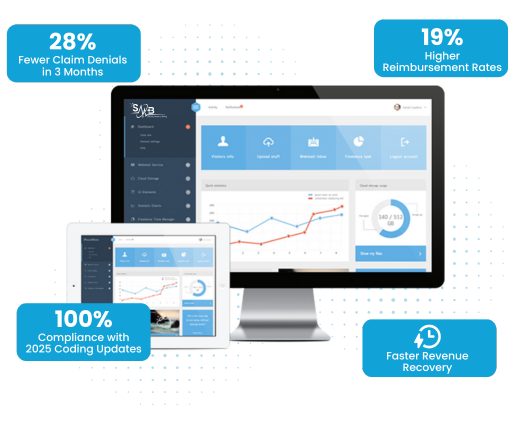
Steady Medical Billing combines medical billing, coding, A/R, denial management, eligibility, and revenue cycle expertise to support practices throughout the billing lifecycle.
Coding specialists work with CPT, ICD-10, HCPCS, modifiers, and payer requirements.
The billing process is viewed as a connected revenue cycle—from eligibility and charge capture through claims, payments, denials, and A/R.
Steady supports independent providers, specialty groups, clinics, and other healthcare organizations with different billing requirements.
The team works with existing EHR and practice management systems as part of the billing workflow.
Reporting and performance monitoring help practices understand what's happening with claims, denials, payments, and aging receivables.
Billing and coding workflows are managed with attention to payer requirements and healthcare compliance.
Schedule a Consultation