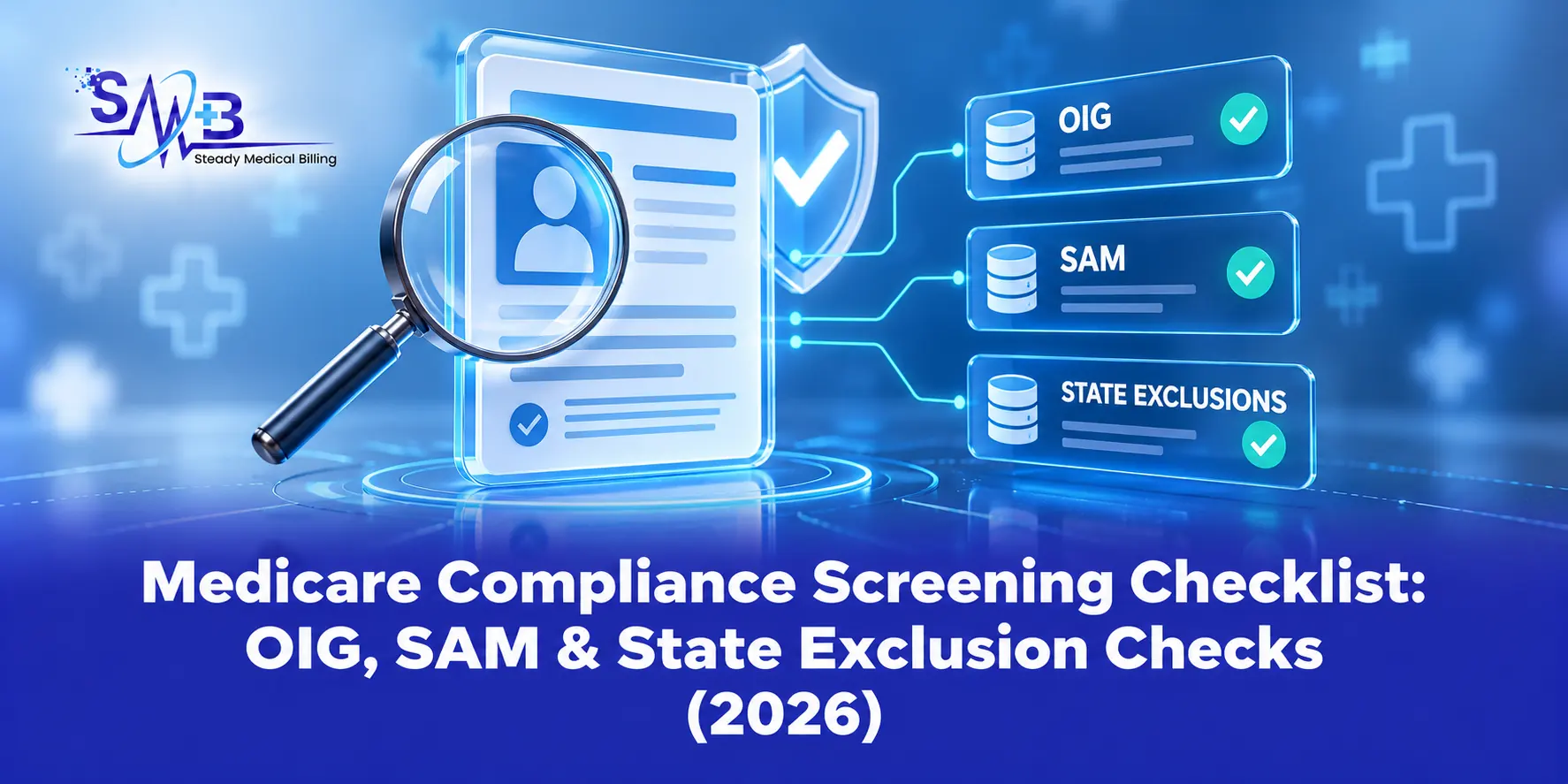
To screen for Medicare compliance, check every employee, provider, contractor and vendor against the OIG List of Excluded Individuals/Entities (LEIE), SAM.gov and, if you bill Medicaid, your state’s Medicaid exclusion list, before hire and then monthly. Pair that with ongoing license monitoring and regular coding audits against NCCI edits and Medicare coverage policies. Keep proof of every check. Billing Medicare for items or services furnished, ordered or prescribed by an excluded person creates overpayments and exposure to civil monetary penalties.
Exclusion screening is one of the simplest compliance controls a practice can run, and one of the most expensive to skip. A single excluded nurse, biller or locum on payroll can turn months of claims into overpayments. This checklist covers which lists to check, how often, what to do when you find a match, and how screening fits into a full Medicare compliance program.
Key Takeaways
- Check the OIG LEIE and SAM.gov for everyone who touches federal health care program work, including employees, contractors, billing vendors and locums, before engagement and at least monthly after.
- If you participate in Medicaid, also check your state’s Medicaid exclusion or termination list. Many states require monthly checks through their provider agreements.
- Exclusion is only one part of compliance. Add license and board monitoring, coding audits, and the seven elements of OIG’s General Compliance Program Guidance.
- Document every search (date, list, name, result) and keep the records. If you find a match, stop billing for that person’s services and evaluate overpayments and self-disclosure.
Which Lists to Check
| List | Who maintains it | What it tells you |
|---|---|---|
| LEIE | HHS Office of Inspector General (OIG) | Individuals and entities excluded from Medicare, Medicaid and other federal health care programs. Updated monthly. |
| SAM.gov exclusions | U.S. General Services Administration | Parties debarred or excluded across federal programs, including some health care exclusions not on the LEIE |
| State Medicaid exclusion/termination lists | Each state Medicaid agency | Providers excluded or terminated from that state’s Medicaid program |
| State licensing boards | Medical, nursing and other boards | License status, restrictions, probation and disciplinary actions |
| Medicare Preclusion List | CMS | Prescribers and providers that Medicare Advantage plans and Part D sponsors can’t pay. Useful if you see MA patients or prescribe Part D drugs |
How Often to Screen
Screen before hiring or contracting anyone, and at least monthly after that. OIG updates the LEIE monthly, and a person can be excluded at any time after you hire them. CMS requires state Medicaid agencies to check providers against federal exclusion databases monthly, and many states pass a monthly screening requirement on to enrolled providers in their Medicaid provider agreements. For practices that bill Medicaid, monthly screening is usually a contractual obligation, not just a best practice.
Medicare Compliance Screening Checklist
- Build the roster. List all employees, providers, contracted clinicians, locums, board members, billing and coding vendors, and key suppliers.
- Collect identifiers. Gather full legal name, former names, date of birth, NPI and, for LEIE verification, SSN or EIN.
- Screen before engagement. Check the LEIE, SAM.gov, your state Medicaid list(s) and the relevant licensing board before the start date.
- Re-screen monthly. Run the whole roster against the updated lists every month, manually or with screening software.
- Monitor licenses and credentials. Track license, DEA and board certification expirations and board actions continuously, not just at recredentialing.
- Flow it down to vendors. Require billing companies, staffing agencies and other contractors to screen their staff and attest to it in writing.
- Document every check. Save the date, list, search terms and result (a screenshot or report) for each person, and keep the records with your compliance files.
- Escalate matches immediately. Verify a potential match using the identifiers, then follow the response steps below.
What to Do If You Find an Excluded Person
- Confirm the match with the LEIE’s SSN/EIN verification feature, not just the name.
- Remove the person from any work connected to federal health care program items or services right away.
- Stop billing for items or services they furnished, ordered or prescribed.
- Work with health care counsel to quantify any overpayments. Under the Medicare overpayment rule, identified overpayments must be reported and returned within 60 days, after a reasonable investigation period.
- Evaluate whether to use the OIG Self-Disclosure Protocol, which generally results in lower penalties than an OIG-initiated case.
- Find the gap in your process (for example, a vendor that never screened) and fix it.
Beyond Exclusions: The Rest of a Medicare Compliance Program
OIG’s General Compliance Program Guidance (November 2023) describes seven elements of an effective compliance program. Small practices can scale each one to their size:
| Element | What it looks like in a practice |
|---|---|
| 1. Written policies and procedures | Code of conduct, billing and coding policies, exclusion screening policy |
| 2. Compliance leadership and oversight | A named compliance officer with authority and time, and leadership oversight |
| 3. Training and education | Annual compliance and coding training, plus onboarding training |
| 4. Effective lines of communication | A way to report concerns, including anonymously, without retaliation |
| 5. Enforcing standards | Consistent consequences for violations and incentives for compliance |
| 6. Risk assessment, auditing and monitoring | Coding and documentation audits, E/M level reviews, exclusion screening |
| 7. Responding to offenses and corrective action | Investigating issues, refunding overpayments and fixing root causes |
For element 6, focus coding audits where risk is highest: E/M level distribution, modifier 25 and 59 use, high-dollar procedures, and services with Medicare coverage policies (NCDs and LCDs). See how payers watch for this in our guide to upcoding and downcoding, and how our coding audit team runs these reviews.
Credentialing and compliance overlap. The same license, sanction and exclusion monitoring that keeps you compliant also keeps payer enrollments active. See our credentialing services for ongoing monitoring support.
Not sure where your compliance gaps are? Steady Medical Billing will review a sample of your claims, coding and screening process at no cost. Request your free RCM audit.
Frequently Asked Questions
How do you screen for Medicare compliance?
Check all employees, providers, contractors and vendors against the OIG LEIE, SAM.gov and your state Medicaid exclusion list before engagement and at least monthly, monitor licenses continuously, audit coding against NCCI edits and Medicare coverage policies, and document every check as part of a compliance program built on OIG’s seven elements.
How often should you check the OIG exclusion list?
Before hiring or contracting, and at least monthly after that. OIG updates the LEIE monthly, and many state Medicaid programs require monthly screening of employees and contractors as a condition of participation.
What happens if a practice employs an excluded individual?
Claims for items or services the excluded person furnished, ordered or prescribed are not payable by federal health care programs, so they become overpayments that must be repaid. The practice can also face civil monetary penalties and assessments. Remove the person from federal program work, stop billing their services, and evaluate self-disclosure with counsel.
Do I need to check SAM.gov as well as the OIG LEIE?
Yes, it is best practice. SAM.gov lists parties excluded or debarred across federal programs, and some exclusions appear there but not on the LEIE. Many state Medicaid agencies and managed care contracts expect both, plus the state’s own exclusion list.
What are the seven elements of a compliance program?
Per OIG’s General Compliance Program Guidance: written policies and procedures; compliance leadership and oversight; training and education; effective lines of communication; enforcing standards; risk assessment, auditing and monitoring; and responding to detected offenses with corrective action.