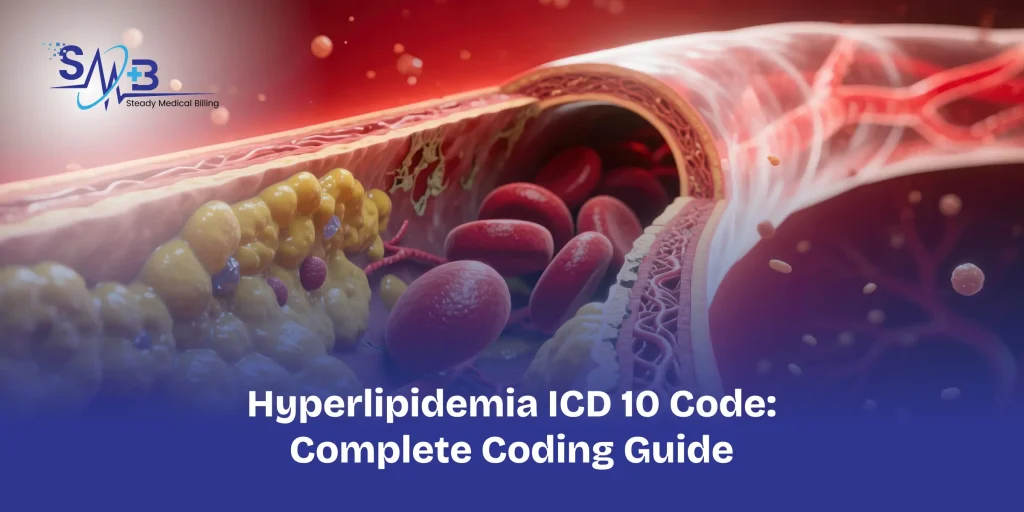
Do you code hyperlipidemia cases every day? Are you confused about proper ICD 10 codes? Hyperlipidemia affects over 93 million American adults today. Studies show 38% of adults have high cholesterol levels. The main code is E78 for disorders of lipoprotein metabolism. This guide explains hyperlipidemia ICD 10 coding completely today. We show the right codes to use correctly. You will learn when to apply each one.
Understanding Hyperlipidemia ICD 10 Codes
Hyperlipidemia has specific ICD 10 codes available. Multiple codes describe different lipid disorders well.
Primary Hyperlipidemia Codes
| ICD 10 Code | Description | Common Usage |
| E78.5 | Hyperlipidemia, unspecified | When specific type unknown |
| E78.0 | Pure hypercholesterolemia | High cholesterol only |
| E78.1 | Pure hyperglyceridemia | High triglycerides only |
| E78.2 | Mixed hyperlipidemia | Both cholesterol and triglycerides high |
| E78.4 | Other hyperlipidemia | Specific genetic forms |
E78.5 is the most common unspecified code used. Use this when the lipid panel is abnormal, but the type is unclear. E78.0 applies when only cholesterol is elevated. E78.1 covers cases with only high triglycerides shown. E78.2 is for both cholesterol and triglycerides elevated.
Familial and Genetic Forms
| ICD 10 Code | Description | When to Use |
| E78.01 | Familial hypercholesterolemia | Genetic high cholesterol |
| E78.3 | Hyperchylomicronemia | Rare genetic lipid disorder |
| E78.49 | Other hyperlipidemia | Specific genetic types |
| E78.6 | Lipoprotein deficiency | Low HDL cholesterol |
Code Selection Guidelines
Match codes to specific lab test results documented. Document actual cholesterol and triglyceride values in records. Use the most specific code based on the lipid panel. Include family history when coding familial forms. Review lab reports before selecting the final code.
Hyperlipidemia Diagnosis Documentation
Proper docs support hyperlipidemia diagnosis codes always today. Insurance companies review lipid disorder claims carefully now.
Required Documentation Elements
| Documentation Type | Required Information | Example |
| Lab Values | Actual cholesterol numbers | “Total cholesterol 245 mg/dL” |
| Triglyceride Levels | Specific triglyceride results | “Triglycerides 180 mg/dL” |
| HDL and LDL | Both values documented | “LDL 160, HDL 35 mg/dL” |
| Previous Results | Historical lab trends | “Last year, total cholesterol 220.” |
| Risk Factors | Cardiovascular risk assessment | “Smoker, family history CAD” |
Medical Necessity Documentation
Every hyperlipidemia diagnosis needs a medical necessity justification clearly shown. Document risk factors that led to lipid testing. Include physical exam findings like xanthomas if present. Previous cardiovascular events should guide treatment decisions made.
Coding Documentation Best Practices
- Document specific lipid panel values, not just abnormal results
- Include the cardiovascular disease risk score when calculated
- Note patient adherence to previous treatment attempts tried
Types of Hyperlipidemia and Codes
Hyperlipidemia has several distinct types today. Each type requires specific ICD 10 coding.
Pure Hypercholesterolemia
| Lab Finding | ICD 10 Code | Criteria |
| High total cholesterol only | E78.0 | Total cholesterol >200 mg/dL |
| High LDL only | E78.0 | LDL >130 mg/dL |
| Familial form | E78.01 | Genetic testing positive |
Pure Hypertriglyceridemia
| Lab Finding | ICD 10 Code | Criteria |
| High triglycerides only | E78.1 | Triglycerides >150 mg/dL |
| Very high triglycerides | E78.1 | Triglycerides >500 mg/dL |
| Severe hypertriglyceridemia | E78.1 | Triglycerides >1000 mg/dL |
Mixed Hyperlipidemia
Mixed hyperlipidemia involves both cholesterol and triglycerides being elevated. Use E78.2 for this combination pattern shown. This type is most common in metabolic syndrome. Document both abnormal values in medical records.
Coding for Different Clinical Scenarios
Different clinical situations require different coding approaches today. Each scenario has unique documentation standards required now.
Primary Care Screening
| Scenario | Primary Code | Supporting Codes |
| Routine screening abnormal | E78.5 | Z13.6 (Lipid screening) |
| Follow-up visit | E78.0 or E78.2 | Z79.899 (Statin use) |
| Medication adjustment | E78.5 | Z91.14 (Noncompliance) |
Cardiology Specialty Visits
Cardiologists manage complex lipid disorders frequently today. Use specific codes based on detailed lipid panels. Document cardiovascular disease present if applicable. Include imaging results like carotid ultrasound findings.
Endocrinology Coding
Endocrinologists treat familial and genetic forms often. Use E78.01 for familial hypercholesterolemia cases clearly. Document genetic counseling and testing performed always. Include family pedigree when familial forms are suspected.
Related Conditions and Comorbidities
Hyperlipidemia often occurs with other conditions today. Proper coding captures all related diagnoses shown.
Metabolic Syndrome Components
| Condition | ICD 10 Code | Relation to Hyperlipidemia |
| Type 2 diabetes | E11.9 | Worsens lipid control |
| Hypertension | I10 | Increases cardiovascular risk |
| Obesity | E66.9 | Common cause of hyperlipidemia |
| Metabolic syndrome | E88.81 | Includes hyperlipidemia |
Cardiovascular Complications
Hyperlipidemia leads to cardiovascular disease over time. Document atherosclerosis with specific location codes used. Include history of MI or stroke if present. Code peripheral artery disease when diagnosed.
Medication-Related Codes
Document all lipid-lowering medications currently prescribed clearly. Use Z79.899 for long-term statin use. Include noncompliance codes when medication adherence is poor. Document side effects from statins when present.
Conclusion
Hyperlipidemia ICD 10 coding requires specific diagnosis codes. E78.5 is for unspecified hyperlipidemia cases shown. Use specific codes E78.0-E78.2 based on lab values. Proper documentation supports medical necessity for claims. Understanding lipid patterns prevents coding errors. Insurance coverage depends on accurate coding practices.
FAQs
What is the ICD 10 code for hyperlipidemia?
E78.5 is the code for unspecified hyperlipidemia. Use this when the lipid panel is abnormal. Specific codes E78.0-E78.2 are better when the type is known.
How do you code mixed hyperlipidemia?
Use E78.2 for mixed hyperlipidemia cases shown. This applies when both cholesterol and triglycerides are elevated.
What is the difference between E78.0 and E78.5?
E78.0 is for pure high cholesterol only. E78.5 is an unspecified lipid disorder type. Use E78.0 when only cholesterol is elevated.
Do you code hyperlipidemia with statin use?
Yes, code both the condition and treatment. Use the E78 code for hyperlipidemia diagnosis. Add Z79.899 for long-term statin therapy.
What lab values support hyperlipidemia coding?
Total cholesterol above 200 mg/dL is abnormal. LDL above 130 mg/dL supports coding. Triglycerides above 150 mg/dL are elevated.