Incorrect CPT codes, missing telehealth modifiers, and wrong place of service (POS) codes can delay mental health reimbursements and trigger claim denials. In 2026, behavioral health billers must also track Medicare policy changes and payer-specific requirements to submit accurate claims.
The Centers for Medicare & Medicaid Services (CMS) maintains a telehealth services list containing more than 250 billable codes. Medicare telehealth flexibilities have also been extended through December 31, 2027, including the waiver of certain in-person visit requirements for behavioral health telehealth. These rules affect billing decisions, but coverage still depends on the service and applicable requirements.
This guide explains telehealth mental health CPT codes, modifiers 95, GT, and 93, and the difference between POS 02 and POS 10. It also covers a key 2026 change: starting October 1, 2026, RHCs and FQHCs must report individual CPT or HCPCS codes with the appropriate telehealth modifier instead of using G2025 for applicable distant-site telehealth services.
What Are Telehealth Mental Health CPT Codes?
Telehealth mental health CPT codes identify psychiatric evaluations, psychotherapy sessions, and other behavioral health services delivered remotely. Choosing the correct code requires reviewing the service performed, documentation, delivery method, and payer coverage rules.
How Telehealth CPT Coding Works for Behavioral Health
Behavioral health providers use CPT codes to report the specific services delivered during a virtual appointment. Common examples include 90791 for psychiatric diagnostic evaluation, 90834 for a 45-minute psychotherapy service, and 90837 for a 60-minute psychotherapy service, subject to applicable CPT coding rules.
Before submitting a claim, confirm:
Service provided: Match the code to the actual evaluation, psychotherapy session, or other documented service.
Session duration: Verify the applicable time requirements and documentation for time-based psychotherapy codes.
Telehealth eligibility: Check whether the payer covers the service through audio-video or audio-only communication.
Claim requirements: Confirm the required modifier, place of service (POS), authorization, and provider eligibility.
Telehealth vs. In-Person Mental Health Billing
Telehealth and in-person appointments may use the same CPT code when the same eligible service is provided. However, telehealth claims may require additional information about the delivery method, patient location, and payer-specific billing rules.
For example, a psychotherapy session may use CPT 90834 whether delivered in person or by video, provided the service and documentation support the code. The appropriate POS and any required modifier must still follow the payer’s current instructions.
CPT Codes, Modifiers, and POS Codes: Key Differences
These three elements communicate different information on a claim:
CPT code: Identifies the service performed.
Modifier: Adds information about how the service was delivered or another applicable billing circumstance.
POS code: Identifies the setting where the patient received the service. POS 02 generally applies to telehealth outside the patient’s home, while POS 10 applies to telehealth in the patient’s home.
Common Telehealth Mental Health CPT Codes in 2026
The correct CPT code depends on the service provided, clinical documentation, and applicable coding rules. Use this reference to identify common behavioral health codes, then verify telehealth coverage and payer-specific billing requirements.
Psychiatric Diagnostic Evaluation Codes: 90791 and 90792
| CPT Code | Description | Key Billing Consideration |
| 90791 | Psychiatric diagnostic evaluation without medical services | Document the psychiatric assessment and clinical findings. |
| 90792 | Psychiatric diagnostic evaluation with medical services | Documentation must support the medical services included in the evaluation. |
Individual Psychotherapy Codes: 90832, 90834, and 90837
| CPT Code | Psychotherapy Time | Key Billing Consideration |
| 90832 | 16–37 minutes | Document the psychotherapy service and time. |
| 90837 | 38–52 minutes | Ensure the documented time supports the selected code. |
| 90838 | 53 minutes or more | Confirm that the clinical note supports the service and time billed. |
Psychotherapy Add-On Codes: 90833, 90836, and 90838
| CPT Code | Psychotherapy Time | Key Billing Consideration |
| 90833 | 16–37 minutes | Report with an eligible E/M service when requirements are met. |
| 90836 | 38–52 minutes | Document the psychotherapy and separately reportable E/M service. |
| 90838 | 53 minutes or more | Ensure the documentation supports both services and applicable time requirements. |
Crisis Psychotherapy Codes: 90839 and 90840
| CPT Code | Description | Key Billing Consideration |
| 90839 | Psychotherapy for a crisis, first 60 minutes | Document the crisis, clinical intervention, and time spent. |
| 90840 | Each additional 30 minutes of crisis psychotherapy | Report only when the additional time and applicable coding requirements are supported. |
Family and Group Psychotherapy Codes: 90846, 90847, and 90853
| CPT Code | Description | Key Billing Consideration |
| 90846 | Family psychotherapy without the patient present | Document participating family members and the clinical purpose. |
| 90847 | Family psychotherapy with the patient present | Record the patient’s participation and the service provided. |
| 90853 | Group psychotherapy | Document the group service, clinical interventions, and participation as required. |
Place of Service Code for Virtual Psychiatry: POS 02 vs. POS 10
POS codes identify where a patient receives a telehealth service, while modifiers communicate additional claim details. Selecting the correct POS helps prevent billing errors, but the final choice must follow the applicable payer’s current rules.
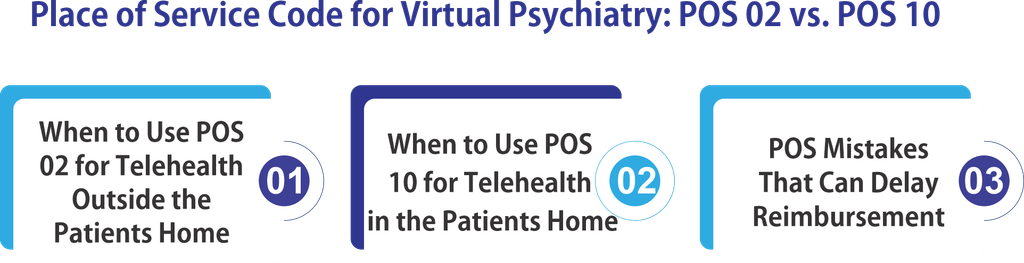
When to Use POS 02 for Telehealth Outside the Patient’s Home
POS 02: Telehealth Provided Other than in the Patient’s Home
Use POS 02 when a patient receives a telehealth service somewhere other than their home. For example, a patient may attend a virtual psychiatry appointment from their workplace or another location outside their residence.
Confirm the patient’s location at the time of service. Do not choose the POS based on the clinician’s office address.
When to Use POS 10 for Telehealth in the Patient’s Home
POS 10: Telehealth Provided in the Patient’s Home
Use POS 10 when the patient receives the telehealth service at home, such as during a remote psychotherapy session from their private residence.
Document the patient’s location and follow the payer’s instructions for the specific service and claim type. POS 10 identifies the setting; it does not independently establish coverage or guarantee reimbursement.
Can You Bill POS 10 With Modifier 95?
Yes. POS 10 and modifier 95 may be reported together when the applicable payer’s billing rules support both.
POS 10: Identifies telehealth provided while the patient is at home.
Modifier 95: Identifies a synchronous telemedicine service delivered through real-time audio-video communication.
These codes serve different purposes. However, do not assume modifier 95 is required for every payer or every telehealth service. Check the current billing instructions before submitting the claim.
POS Mistakes That Can Delay Reimbursement
Common POS errors include:
Using POS 02 for a patient at home: Confirm the patient’s actual location before selecting the code.
Using POS 10 for a patient outside the home: Check whether POS 02 applies.
Basing POS on the provider’s location: Record where the patient received the service.
Adding a modifier without checking payer rules: Verify the required modifier, service eligibility, and claim instructions.
Medicare Telehealth Mental Health Billing Requirements for 2026
Medicare covers eligible mental health services delivered through telehealth, subject to provider, service, and documentation requirements. Billers should verify current CMS guidance before selecting CPT codes, modifiers, and POS codes.
Eligible Providers and Covered Telehealth Services
Medicare-eligible practitioners may include physicians, nurse practitioners, physician assistants, clinical psychologists, clinical social workers, marriage and family therapists, and mental health counselors, subject to applicable requirements.
Covered services must meet Medicare’s eligibility and billing rules. Verify the current telehealth services list and document the service provided.
Medicare Audio-Only Mental Health Visits
Through December 31, 2027, Medicare allows eligible telehealth services, including qualifying mental health visits, to be provided through real-time audio-only communication when requirements are met.
Document the communication method and confirm that the service qualifies. Audio-only coverage does not mean every CPT code or service is eligible.
In-Person Visit Requirements and Applicable Exceptions
Medicare’s in-person visit requirement for mental health telehealth services is deferred until after December 31, 2027. Eligible patients can continue receiving covered mental health telehealth services without meeting that requirement during the current extension.
Practices should monitor CMS updates and maintain complete clinical records. Any future in-person visit requirements and applicable exceptions should be reviewed before billing.
Medicare Advantage vs. Original Medicare Billing Rules
Original Medicare claims must follow CMS coverage, coding, modifier, and POS requirements. Providers should confirm the patient’s eligibility and document the service before submitting a claim.
Medicare Advantage plans may have their own network, authorization, and claim-submission procedures. Check the specific plan’s billing guidance rather than assuming Original Medicare rules apply in every situation.
RHC and FQHC Considerations, Where Applicable
Rural Health Clinics (RHCs) and Federally Qualified Health Centers (FQHCs) generally bill eligible behavioral health telehealth services under their applicable payment systems: the
All-Inclusive Rate (AIR) for RHCs and the Prospective Payment System (PPS) for FQHCs.
Starting October 1, 2026, eligible non-behavioral health distant-site telehealth services must use individual CPT or HCPCS codes instead of G2025, with the appropriate modifier. This change does not replace the existing AIR/PPS approach for behavioral health telehealth.
Billing Online Therapy Insurance Requirements
Insurance requirements for online therapy vary by plan, provider, service, and delivery method. Verify benefits and payer rules before submitting claims to reduce denials and payment delays.
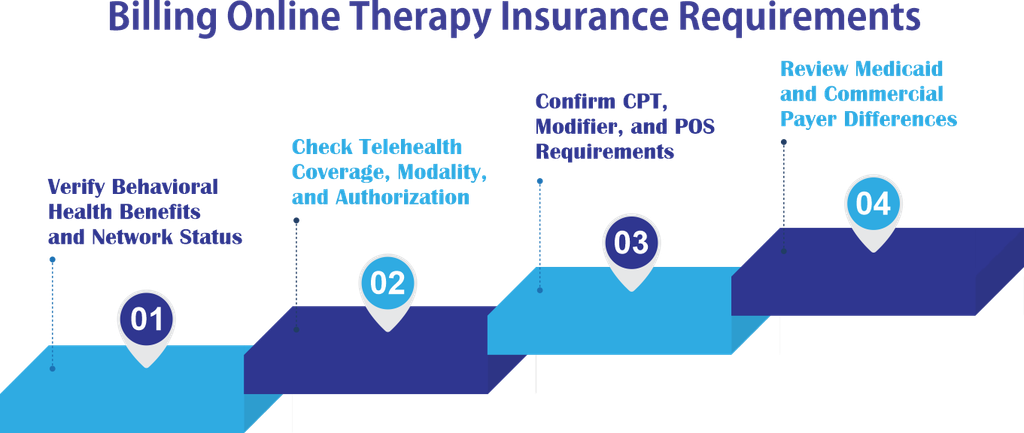
Verify Behavioral Health Benefits and Network Status
Confirm that the patient’s plan covers the behavioral health service and check copays, deductibles, visit limits, and referral requirements. Verify the provider’s network status and eligibility for reimbursement.
Remember that insurance acceptance does not guarantee coverage for every online therapy service. Record the benefit verification details and any limitations before the appointment.
Check Telehealth Coverage, Modality, and Authorization
Check whether the plan covers the intended therapy service through telehealth and whether it permits live audio-video or audio-only visits. Some payers may restrict coverage based on the service, provider type, or communication method.
Confirm whether prior authorization or a referral is required before treatment. Document authorization details and follow the payer’s rules for each date of service.
Confirm CPT, Modifier, and POS Requirements
Choose the CPT code that accurately represents the mental health service provided and the documented time, when applicable. Verify whether the payer requires modifier 95, GT, 93, or another modifier for the delivery method.
Select POS 02 for telehealth provided somewhere other than the patient’s home or POS 10 when the patient receives telehealth at home, following the payer’s instructions. Do not assume one billing combination applies to every insurer.
Review Medicaid and Commercial Payer Differences
Medicaid telehealth coverage and billing rules vary by state and may differ by managed care plan. Check the applicable state Medicaid manual and plan guidance for covered services, eligible providers, modifiers, POS codes, and authorization requirements.
Commercial insurers also set plan-specific rules for online therapy, including network participation and claim submission. Review the current payer policy before billing, and retain supporting documentation for claim follow-up or appeals.
Conclusion
Accurate telehealth mental health billing requires the right CPT codes, modifiers, and place of service (POS) codes. Understanding Medicare policies and insurance requirements helps mental health practices reduce claim errors, avoid denials, and support timely reimbursements.
Use this guide to verify psychotherapy codes, distinguish POS 02 from POS 10, and understand modifiers 95, GT, and 93. Follow current CMS and payer guidelines to submit compliant telehealth claims and protect your practice’s revenue.
FAQs
What are the most common telehealth mental health CPT codes?
Common codes include 90791 and 90792 for psychiatric diagnostic evaluations, 90832, 90834, and 90837 for individual psychotherapy, and 90846, 90847, and 90853 for family and group therapy. Coverage depends on payer rules and service requirements.
What is the difference between modifiers 95 and GT for telehealth?
Modifier 95 generally identifies synchronous telemedicine services delivered through real-time audio-video communication. Modifier GT is used in certain payer-specific billing contexts, so verify current Medicare or insurer requirements before submitting claims.
What is the difference between POS 02 and POS 10 for telehealth mental health services?
POS 02 indicates telehealth provided somewhere other than the patient’s home, while POS 10 indicates telehealth provided in the patient’s home. Select the code based on the patient’s location and applicable payer instructions.
Does Medicare cover online mental health therapy in 2026?
Yes, Medicare covers eligible mental health services delivered through telehealth when applicable provider, service, and billing requirements are met. Current flexibilities allow qualifying telehealth services, including audio-only visits, under applicable rules through December 31, 2027.
What should providers verify before billing insurance for online therapy?
Providers should verify behavioral health benefits, network status, telehealth coverage, authorization requirements, CPT codes, modifiers, and POS codes. Checking the payer’s current policy and maintaining complete documentation can help reduce claim denials and payment delays.