
The claim finishes. Payer pays its share, the contracted adjustment comes off, and one number is left sitting on the screen: what the patient owes. Every billing office knows that number. Fewer of them enjoy chasing it, because the money is real, the patient almost never expected it, and the rules around collecting it are stricter than most people guess.
Here is the part worth internalizing. Compliant collection is not a tax on revenue, it is the version of collection that actually works. Patients pay balances they understand, in writing, with a fair way to push back. Rushed, vague, pushy collection produces disputes, refunds, and chargebacks that eat the gain. So the structure below does double duty: patient balance billing rules tell you what you may do, and plain old human factors tell you what works.
Understanding patient co-pay and deductible collection
| Balance type | What it is | When to collect it |
| Copay | Fixed fee per visit under the plan | At check-in |
| Deductible | What a patient pays before the plan starts paying | Estimated up front, billed after adjudication |
| Coinsurance | A percentage of the allowed amount | Billed after adjudication |
| Non-covered service | Something the plan refuses to cover | Billed only after advance notice |
| Out-of-network cost share | The patient’s bigger share for out-of-network care | Billed after the plan finalizes, within legal limits |
Money collected at the front desk is money you never have to bill. Copays are due at the visit, period, and the copay bowl at check-in costs a fraction of what a printed statement costs thirty days later.
Deductibles and coinsurance are trickier, and it is nobody’s fault. Nobody knows the exact patient share until the claim adjudicates. What closes that gap is the eligibility response: run it before the visit and it will tell you the deductible used so far, what remains, and the coinsurance split. Quote those numbers, take the copay, write the estimate down. A practice that does these three things has quietly done most of the work behind understanding patient co-pay and deductible collection, and the statement afterward is just arithmetic.
How to collect patient responsibility after insurance, step by step
Sequence beats volume every time. When the primary EOB posts, reconcile it before anything else moves: allowed amount, plan payment, contractual adjustment, remainder. Until those four numbers agree with the EOB, nobody in the office actually knows what the patient owes.
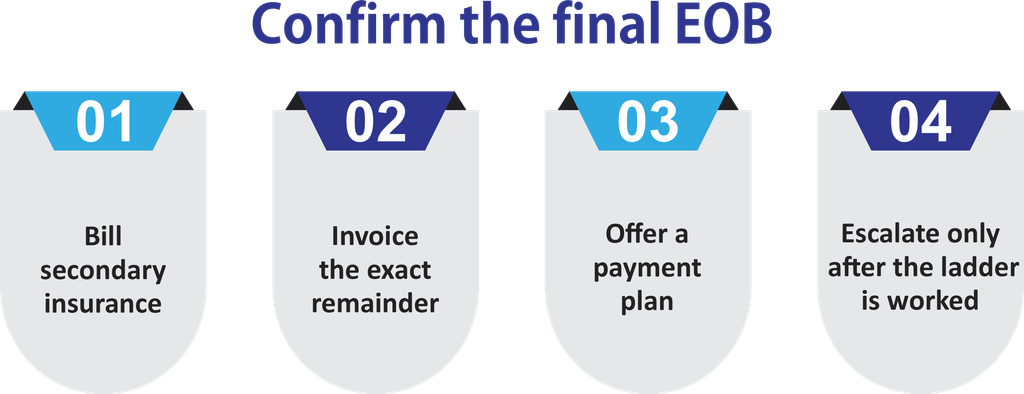
Then, and only then, look for a secondary payer. A claim that jumps from primary straight to the patient’s mailbox is the classic expensive mistake, because the second plan often owed part of that balance and now the practice has to recall an invoice and eat the embarrassment. Accurate, prompt secondary claims answer half of how to collect patient responsibility after insurance. The other half is invoicing the exact remainder, once, with the explanation attached.
The difference between balance billing and billing secondary insurance
On paper these two can look identical. Legally they are opposites. Billing secondary insurance means sending the unpaid remainder to another payer that might owe it. Balance billing means leaning on the patient for whatever the insurer declined. In a contracted relationship, the disallowed amount is a write-off by contract, and pushing it onto the patient is not aggressive, it is a breach. The difference between balance billing and billing secondary insurance really reduces to one question: who owns the remainder? A payer that might owe it gets a claim. An amount the contract disallowed gets written off. Whatever the plan design assigns to the patient gets a statement.
Balance billing regulations for healthcare providers
The federal floor has been the No Surprises Act since January 1, 2022. Emergency care, certain non-emergency services from out-of-network clinicians working inside in-network facilities, and out-of-network air ambulance are all off-limits for balance billing, and in those situations the patient’s share caps at in-network cost-sharing. There are narrow notice-and-consent exceptions, for post-stabilization care and scheduled non-emergency out-of-network care at in-network facilities, and they demand written consent before a balance can be pursued. CMS keeps a plain-language summary of these balance billing protections that makes decent staff-training material.
Above that floor, two more layers. Medicare and Medicaid assignment rules already shield those patients from most balance billing, and quite a few states stack their own limits on top of federal law. Balance billing regulations for healthcare providers end up being a stack of requirements, and the practice’s own payer contracts are usually the strictest layer of the lot.
Medical billing patient statement best practices
A statement is the practice talking on paper, so it should sound like a person. The ones that get paid share a shape: itemized charges, the insurance payment and the adjustment printed right beside each line, the exact balance, a due date, the ways to pay, and a phone number that a human answers.
Plain language does most of the lifting. “You may owe $84.30,” next to a line-by-line table, gets paid. A bare total wrapped in jargon generates phone calls instead of payments. Good medical billing patient statement best practices also set a rhythm, first statement within days of final adjudication, a reminder around thirty days, and a cadence steady enough that no patient is ever surprised by which letter just arrived.
Managing patient accounts receivable in healthcare
Patient A/R is worked like a ladder, not a cliff. Balances age in 30, 60, and 90-day buckets, and each bucket gets its own move: statement, then reminder with a payment plan offer, then an actual phone call. Payment plans deserve far more use than they get. A $1,200 balance is usually a cash-flow problem, not a refusal, and a signed twelve-month agreement will out-collect a third notice by a wide margin.
The quieter half of managing patient accounts receivable in healthcare happens before any escalation: screening for help. Plenty of patients qualify for charity care, prompt-pay discounts, or hardship policies and never ask. Offering that screen before an outside collection step is the ethical route, and it also happens to recover the most revenue.
Handling disputed medical bills ethically
| Dispute cause | What usually happened | The fix |
| Surprise out-of-network charge | An OON clinician worked at an in-network facility | Check NSA protections before billing |
| Claim billed to the wrong payer | Eligibility was never verified | Verify at every visit |
| Blurred statement | No line-by-line detail | Reissue itemized |
| Secondary never billed | Claim moved to the patient too early | Bill secondary, reissue the corrected balance |
Treat a dispute the way you treat a denial, because that is what it is, minus the payer. Re-adjudicate the claim, pull the itemized detail, set it against the EOB while the dispute clock runs. The debt collection rulebook points the same direction: on a disputed amount, collection pauses until the debt is verified.
Most disputes trace back to a short list of causes, and each one has a fix the practice controls.
Handling disputed medical bills ethically also means closing the loop in writing: what was found, what changed, what is owed now. When a dispute turns on network status, the CFPB’s surprise medical bill guidance is worth sending the patient.
Automating patient collections for medical practices
Automation belongs on the repetitive parts. Eligibility checks at scheduling, statements generated the day the final EOB posts, text and email reminders on a fixed cadence, a payment portal that sets up plans and card-on-file without a phone call. Practices that hand these jobs to software tend to report the same pair of results: faster first payments and fewer statements bouncing back as undeliverable.
What should stay human is judgment. Automating patient collections for medical practices works when the software escalates gently, offers the payment plan early, and sends anything odd to a person who can read the whole account before deciding.
Conclusion
Handled well, a patient balance is the end of a clean process rather than the start of an argument. Adjudicate fully, bill every payer that might owe, invoice only the true remainder, and do it in statements a patient can read without calling anyone. Practices that would rather not build that machinery in-house can hand the statement cycle, the payment plans, and the dispute loop to dedicated patient billing statements services that run as an extension of the billing office.
FAQs
Can a practice bill a patient for the amount the insurance company wrote off?
No. Under a contract, the disallowed amount is a write-off, and billing the patient for it breaches the payer agreement.
Is balance billing illegal in every situation?
No. The No Surprises Act bans it for emergency care, certain out-of-network services at in-network facilities, and air ambulance. Medicare and Medicaid assignment rules block most of the rest, and several states add limits of their own.
When should the first patient statement go out?
After adjudication is finished, secondary payer included. Billing a patient while a secondary claim is still pending is the most common source of wrong balances.
Do payment plans need to be in writing?
Yes. A written agreement protects both sides. The patient knows the monthly amount and the end date, and the practice has the terms documented.
Can a practice send a medical bill to a collection agency?
Yes. HIPAA’s payment provisions allow sharing the minimum necessary billing information, the agency signs a business associate agreement, and federal debt collection law governs how it may contact the patient.
What should a patient statement include?
Itemized charges, the insurance payment and adjustment beside each one, the exact balance, a due date, payment options, and a contact who can explain the bill.