
Here’s a number that should bother anyone who runs a front office. When Experian Health broke down the causes of claim denials for 2025, the top reasons had nothing to do with medicine. Incomplete or missing registration data accounted for 32% of denials, and prior authorization failures added another 35%. Both begin before the patient ever sees a provider. Both trace back to the same quiet failure, which is that somewhere between scheduling and check-in, nobody confirmed the insurance story was actually true.
That failure has a name, and it’s the subject of this piece. Insurance eligibility verification errors in medical billing are the most common way a practice hands a payer a reason to say no, and unlike most denial causes, this one is entirely on our side of the counter. Payers don’t invent these at random. They deny whatever our intake hands them.
What eligibility verification actually confirms
Ask around a clinic what an eligibility check does, and the usual answer is that it tells you whether the insurance is active. True, and wildly incomplete. A proper check settles five separate questions: is the policy active today (not last month), whose name the coverage sits under, whether the plan pays for this kind of service at all, how the money splits between plan and patient, and, when a second plan exists, which one pays first.
The plumbing for all of this was settled years ago. A practice sends an ASC X12 270 request, the payer answers with a structured 271, and the five answers live somewhere in that reply. Medicare runs the same exchange through the HIPAA Eligibility Transaction System, which CMS keeps open any hour of any day. Real-time eligibility verification in healthcare is already the default, since the CAQH Index counts roughly nine in ten checks running electronically now. When errors still slip through, the pipe is almost never the problem.
Common insurance eligibility mistakes in clinics
Every practice has its own flavor of chaos, yet the mistakes stay strangely uniform, and all of them grow from the same habit of treating a check performed once as a fact forever.
| Mistake | What it looks like | What it costs |
| Stale demographics | Old address, misspelled name, or a transposed digit in the member ID | Rejection before adjudication, usually within days |
| Expired coverage | A policy terminated at a job change nobody reported | Full denial, plus a patient who believed they were covered |
| Wrong payer order | Billing the secondary first or skipping the primary | Both claims deny, and timely filing clocks keep running |
| Missed plan changes | Patient switched plans at open enrollment in January; the file says 2024 | Service-specific denials and a surprised patient |
| Benefit misread | The 271 says the service needs an auth; staff read it as covered | The costliest error here, because the work is already done |
| One-and-done checking | Verified at scheduling, never again | Coverage that lapses between booking and the visit goes unnoticed |
Notice what’s missing from that list. There are no coding errors on it and no payer games, just six ways of knowing less than you could have known, for free, before the visit.
How to verify patient insurance coverage accurately
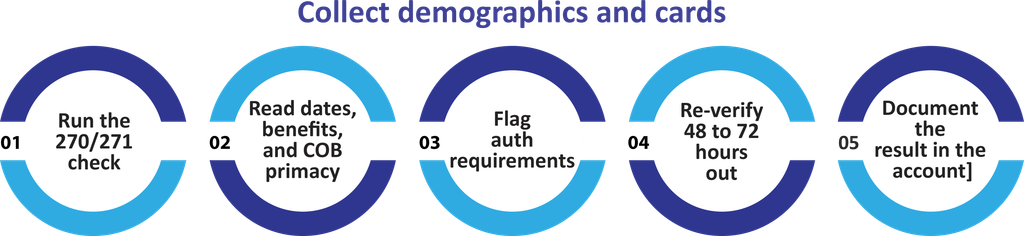
The honest answer to how to verify patient insurance coverage accurately is that no single check earns the word. Coverage moves: a plan that was solid on Monday can lapse by Friday, and job changes, open enrollments, and Medicaid redeterminations don’t send courtesy notices to your front desk. Accuracy comes from frequency rather than care, so the routine that works runs four times, once at scheduling, again 48 to 72 hours out, once on the day of service, and a final pass before the claim goes out to confirm the payer and member ID on the claim actually match the response.
There’s a reading skill involved too. A 271 response runs pages long and nobody absorbs all of it, but three sections decide most outcomes: the coverage dates, the benefit detail for the specific service type, and the coordination of benefits segment naming who pays first. Staff who learn those three catch problems while the patient can still be rescheduled. Staff who skim catch them three weeks later, from the denial.
Pre-authorization vs insurance eligibility verification
It helps to imagine two different clerks. The eligibility clerk asks about the policy: active, covered, who pays. The authorization clerk asks about this Tuesday’s procedure: did the payer approve it in advance, yes or no. Pre-authorization vs insurance eligibility verification is a real distinction, and blurring it is how both get skipped, because a patient can be perfectly eligible and still need an approval the eligibility response never granted.
The auth side is where the money burns. Prior authorization problems drive 35% of claim denials by Experian Health’s count, the largest single cause the firm tracks, so the pre-visit checklist needs two boxes rather than one: coverage confirmed, and, where the service type requires it, approval in hand. Checking one and assuming the other is how a clean visit turns into a write-off.
Consequences of inactive insurance on medical claims
The consequences of inactive insurance on medical claims don’t arrive as one clean event. They pile up. The service happens, because nobody had a reason to stop it. The claim gets built, submitted, and denied weeks later. Someone then re-runs the check that should have caught the problem, which 55% of providers say costs ten minutes or more per pass, and nine out of ten denials still need a human to review before resubmission. None of that labor is billable, and all of it was avoidable.
Patients carry the heavier version. A person who believed they were covered receives a full-charge bill, and the practice inherits a collections conversation that damages a relationship over a visit that was never going to pay cleanly. Timely filing adds a deadline to all of it, since the clock runs from the date of service whether or not the denial was fair.
How to check secondary insurance coverage prior to visit
Roughly a quarter of patients over 65 hold more than one plan, and plenty of younger patients carry secondaries they genuinely forget to mention. The question “any insurance changes?” catches a little of this. The 271’s coordination of benefits segment catches more, since payers track primacy even when patients don’t.
So here’s how to check secondary insurance coverage prior to visit without guessing: run eligibility on both plans before service, confirm the primacy order against payer records, and hold the claim until both are confirmed. Billing the secondary before the primary adjudicates looks efficient and bounces both claims, every single time.
Front desk medical billing workflow checklist
Every eligibility error either happens at the front desk or gets stopped there, which means the fix belongs there. A front desk medical billing workflow checklist that actually functions ties each task to a moment on the calendar, not to “when things calm down.”
| When | What to confirm | Where it lands |
| At scheduling | Demographics, insurance cards both sides, plan name and member ID | Registration fields, not a paper note |
| 48 to 72 hours out | 270/271 run: active coverage, benefits for the service type, COB order | Account note with date and response summary |
| Day of service | Coverage still active, copay collected, auth numbers matched to the visit | Check-in screen, before the patient leaves |
| Before claim entry | Payer ID, member ID, and subscriber name match the 271 exactly | Claim audit, prior to submission |
Reducing front-end medical billing errors
Practices that get ahead of this stop asking staff to memorize a payer’s quirks. Software reads a 271 identically every time and routes the exceptions to a person. Intake gets standardized, which retires the handwritten card, that natural habitat of the transposed digit. Re-verification runs on a schedule instead of on a hunch.
Reducing front-end medical billing errors also has a business case beyond the denial count. Experian’s survey found 69% of organizations using AI in the revenue cycle report fewer denials or better resubmission results, and the CAQH Index estimates $11.7 billion a year is still recoverable from moving the remaining manual checks to electronic ones. None of this requires new science. It requires somebody to decide the current denial rate isn’t the cost of doing business.
Conclusion
Eligibility errors are boring, repetitive, and almost entirely preventable, which is exactly why they deserve attention first. Confirm the five facts, check four times instead of once, read the 271 where it matters, and keep authorization questions out of eligibility answers. Practices that would rather not build the whole apparatus in-house can hand the front-end work, including health insurance eligibility verification, to a team that runs it every day.
FAQs
Is eligibility verification the same as prior authorization?
No, they’re different questions. Eligibility confirms the policy is active and what it pays. Prior authorization is the payer’s advance approval for a specific service. A patient can be fully eligible and still need an auth.
When should eligibility be checked?
Four times: at scheduling, 48 to 72 hours before the visit, on the day of service, and once more before the claim goes out.
What is a 270/271 transaction?
The 270 is the electronic request a practice sends, and the 271 is the payer’s structured reply carrying coverage dates, benefits, and coordination of benefits detail.
Who pays first when a patient has two insurance plans?
Coordination of benefits rules decide, and the payer’s 271 response states the order. Contract language and Medicare involvement can shift it, so read the response instead of assuming.
What happens if a claim goes out on inactive coverage?
It denies. Staff time goes into rework inside the timely filing window, and the patient gets a full-charge bill nobody warned them about.
Can eligibility checks be automated?
Mostly, yes. Nine out of ten already are. Routine volume belongs in software, while complex cases like COB disputes still need a person.