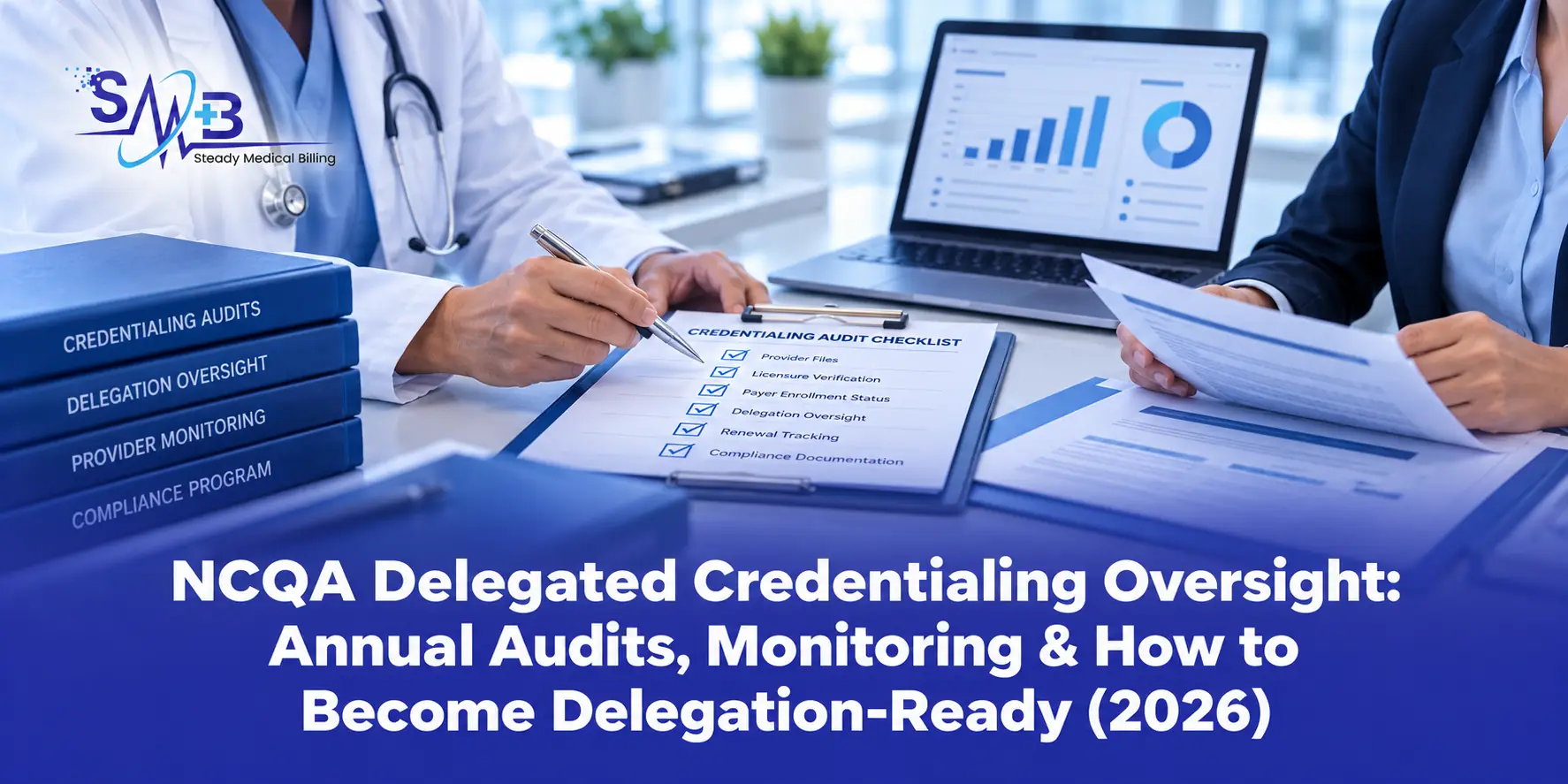
Delegated credentialing oversight is how a health plan makes sure a group, IPA or CVO it has delegated credentialing to still meets NCQA standards. It rests on a written delegation agreement, a pre-delegation evaluation, regular reporting from the delegate, and at least an annual audit of the delegate’s policies and a sample of credentialing and recredentialing files. Since July 1, 2025, NCQA requires time-limited verifications to be no more than 120 days old at the credentialing decision, and the delegate is held to the same rule.
Our delegated credentialing guide explains what delegation is. This post is for the next question health plans and provider groups ask: what does oversight actually involve, what happens in the annual audit, and how does a group become delegation-ready?
Key Takeaways
- NCQA lets a plan delegate credentialing, but the plan stays accountable and must oversee the delegate.
- Oversight has four parts: a written agreement, a pre-delegation evaluation, ongoing reporting, and at least annual audits of policies and files.
- Under the 2025 NCQA standards, time-limited verifications must be no more than 120 days old at the decision (previously 180), and licenses, sanctions and exclusions must be monitored continuously.
- Recredentialing is still required at least every 36 months.
- To become delegation-ready, a group needs NCQA-aligned policies, a credentialing committee, clean files, reliable roster reporting, and an internal audit process.
What NCQA Requires for Delegation Oversight
| Oversight element | What it involves |
|---|---|
| Delegation agreement | A mutually agreed, written document that lists the delegated activities, each party’s responsibilities, reporting requirements, how performance is evaluated, and remedies, including revoking delegation |
| Pre-delegation evaluation | Before delegating, the plan reviews the delegate’s policies, procedures and capacity, usually including a file review |
| Ongoing reporting | The delegate sends rosters and credentialing activity reports at the frequency set in the agreement, often semiannually or quarterly |
| Annual evaluation | The plan reviews the delegate’s policies against current NCQA standards and audits a sample of initial credentialing and recredentialing files |
| Improvement actions | When the audit finds deficiencies, the delegate submits a corrective action plan and the plan follows up until it is fixed |
For Medicare Advantage and Medicaid managed care plans, federal rules and state contracts add their own requirements. For example, Medicare Advantage organizations remain fully responsible to CMS for functions they delegate. Delegates should expect these requirements to be written into the delegation agreement.
How the Annual Delegation Audit Works
- Notice and document request. The plan schedules the audit and asks for current policies, committee minutes, rosters and the file universe for the review period.
- Policy review. Policies are checked against the NCQA credentialing standards in effect for the period, including verification sources, time limits, committee review, monitoring and practitioner rights.
- File sampling. The auditor pulls a sample of initial and recredentialing files. Many plans use NCQA’s 8/30 file-review method, which starts with a small sample and expands it if errors are found.
- File review. Each file is checked for complete primary source verification, verification dates within the time limit, a signed and current attestation, sanctions and exclusion checks, and a committee or medical director decision date.
- Ongoing monitoring review. Evidence that licenses, sanctions, exclusions and complaints were monitored between cycles.
- Findings and corrective action. Deficiencies go into a report. The delegate submits a corrective action plan, and repeated or serious failures can lead to loss of delegation.
The most common audit finding is a verification that was older than the time limit when the committee made its decision. With the 2025 change from 180 to 120 days, files that used to pass can now fail. Check your committee scheduling against the new window.
How to Become Delegation-Ready
- Policies aligned to current NCQA standards, reviewed at least annually and whenever NCQA updates its standards.
- A credentialing committee with participating practitioners and documented, dated decisions.
- Primary source verification workflows for license, DEA/CDS, education and training, board certification, work history, malpractice history, and sanctions and exclusions.
- A verification clock that flags any file approaching the 120-day limit before the committee meets.
- Ongoing monitoring of licenses, Medicare/Medicaid sanctions, OIG and SAM exclusions, and complaints between credentialing cycles.
- 36-month recredentialing tracking, with reminders far enough ahead to collect attestations.
- Accurate roster reporting in each plan’s format, with adds, terms and changes on time.
- An internal file audit run before every plan audit, using the same checklist the plan will use.
Extending delegation to NPs, PAs and behavioral health clinicians
Many groups first get delegation for physicians and later want to add nurse practitioners, physician assistants, psychologists, licensed clinical social workers and counselors. Check the delegation agreement’s scope. Some plans require a separate review or an amendment for each new practitioner type, and state scope-of-practice and supervision rules affect what must be verified. See our NP credentialing services for that workflow.
How Delegation Shortens Verification Cycle Times
Delegation saves time because the group verifies once and reports approvals to every plan that delegates to it, instead of waiting in each plan’s queue. The time savings only hold if the group’s own process is fast: complete applications on day one, automated primary source checks, a fixed committee calendar, and a clean CAQH profile. A backlog at the delegate is still a backlog.
Preparing for a delegation audit, or want to apply for delegation? Our credentialing team can audit your files against current NCQA standards, fix gaps and maintain ongoing monitoring.
Frequently Asked Questions
What are NCQA delegation oversight requirements?
The plan must have a written delegation agreement that defines delegated activities, responsibilities, reporting and remedies; evaluate the delegate before delegating; receive regular reports; and at least annually review the delegate’s policies and audit a sample of credentialing and recredentialing files, following up on any deficiencies.
How do payers audit delegated credentialing?
Usually once a year. The plan reviews the delegate’s credentialing policies against current NCQA standards, pulls a sample of initial and recredentialing files (many use NCQA’s 8/30 method), checks primary source verifications, time limits, attestations, sanctions checks and committee decisions, then issues findings and requires a corrective action plan for deficiencies.
What is the NCQA verification time limit in 2026?
Under NCQA credentialing standards effective July 1, 2025, time-limited verifications must be no more than 120 days old at the credentialing decision for accreditation, down from 180 days. CVO certification uses 90 days.
How often must credentialing be monitored between cycles?
NCQA requires ongoing monitoring of sanctions, exclusions, license limitations and complaints between recredentialing cycles. Many organizations now check at least every 30 days, matching the monthly update cycle of the OIG exclusion list.
Can delegation include nurse practitioners and therapists?
Yes, if the delegation agreement covers those practitioner types. Some plans require a separate review or amendment to add NPs, PAs or behavioral health clinicians, and state scope-of-practice rules affect what must be verified.