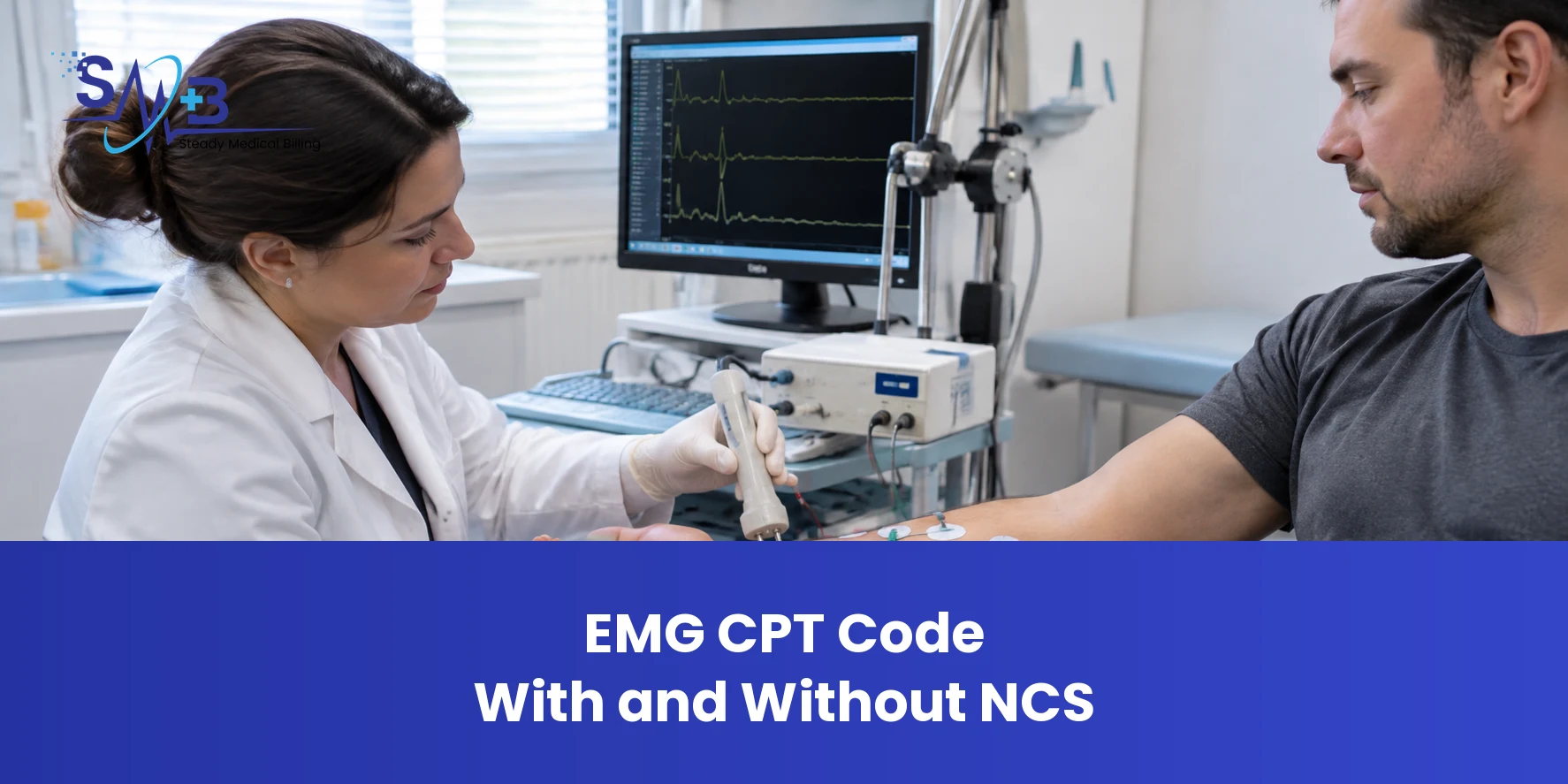
The EMG CPT code depends on one question: did the provider also perform a nerve conduction study (NCS) on the same date? Needle EMG alone uses 95860 to 95864 by the number of extremities. When an NCS happens the same day, you report the NCS with 95907 to 95913 and add the EMG with 95885, 95886 or 95887.
This guide walks through each EMG CPT code, how to count nerve conduction studies, and the pairing rules that cause most electrodiagnostic denials. It reflects the current CPT code set in effect for 2027 claims.
Key Takeaways
- Use 95860 to 95864 for needle EMG of one to four extremities only when no NCS is done that day.
- When NCS and EMG happen on the same date, bill one NCS code (95907 to 95913) plus 95885, 95886 or 95887.
- 95885 (limited) and 95886 (complete) are add-on codes reported once per extremity, up to four units combined.
- Count each type of nerve conduction study once per nerve, no matter how many sites the provider stimulates.
- Never pair 95885 or 95886 with 95860 to 95864, 95870 or 95905 for the same session.
What Is the CPT Code for EMG?
First, there isn’t a single CPT code for EMG. Instead, needle electromyography codes split into two families, and the date of service decides which one applies. When the provider performs needle EMG with no nerve conduction study that day, use the standalone codes. On the other hand, when an NCS happens the same day, the EMG moves to add-on codes that ride on the NCS code.
| EMG CPT code | What it reports | Use it when |
|---|---|---|
| 95860 | Needle EMG, 1 extremity, with or without related paraspinal areas | No NCS that day |
| 95861 | Needle EMG, 2 extremities | No NCS that day |
| 95863 | Needle EMG, 3 extremities | No NCS that day |
| 95864 | Needle EMG, 4 extremities | No NCS that day |
| 95867 / 95868 | Cranial nerve supplied muscles, unilateral / bilateral | No NCS that day |
| 95869 | Thoracic paraspinal muscles (excluding T1 or T12) | No NCS that day |
| 95870 | Limited study of one extremity or non-limb (axial) muscles | No NCS that day |
| +95885 | Limited EMG, each extremity, with NCS | NCS done the same day |
| +95886 | Complete EMG, each extremity, with NCS | NCS done the same day |
| +95887 | Non-extremity (cranial or axial) EMG, with NCS | NCS done the same day |
Besides these, other needle EMG codes cover special studies, such as 95865 for the larynx, 95866 for the hemidiaphragm and 95872 for single fiber EMG. Keep in mind that the code descriptions above are summaries; always confirm the full descriptor in your current CPT book.
EMG Test CPT Code Without a Nerve Conduction Study
So when the provider performs needle EMG alone, choose the code by how many extremities the study covers. For example, an EMG of both legs with no NCS that day is 95861. Also, paraspinal muscles tested with a limb are part of that limb code, so you don’t report them separately.
Code 95870 fits a limited study of muscles in one extremity, or of non-limb (axial) muscles, when no NCS is done. However, CPT doesn’t let you report 95870 alongside the add-on codes 95885 or 95886. As a result, 95870 only appears on claims without a same-day NCS.
CPT Code for EMG With Nerve Conduction Study
Most electrodiagnostic exams include both tests. In that case, the EMG CPT code becomes an add-on: report the NCS first, then add the EMG for each extremity studied:
- First, count the nerve conduction studies and pick one code from 95907 to 95913.
- Add 95886 for each extremity with a complete EMG: five or more muscles supplied by three or more nerves, or four or more spinal levels.
- Add 95885 for each extremity with a limited EMG of fewer than five muscles.
- Add 95887 for non-extremity muscles, such as cranial nerve supplied muscles, or for paraspinal muscles studied without a limb study.
- Finally, stop at four extremity units. 95885 and 95886 can total no more than four units per patient per day.
For example, say a patient has seven nerve conduction studies, a complete EMG of the right arm and a limited EMG of the left arm. The claim carries 95910 for the NCS, 95886 x1 for the right arm and 95885 x1 for the left arm. For a deeper look at the complete-study code, see our CPT code 95886 guide.
Common mix-up: Some code lists still show 95860 to 95864 as deleted. They aren’t. They remain active, but only for days without a nerve conduction study. Billing 95861 with an NCS code is a frequent reason EMG lines deny.
Nerve Conduction Study CPT Code: How to Count Studies
Specifically, codes 95907 to 95913 are tiered by the total number of nerve conduction studies done in the session. Therefore, you report one code for the whole session, not one code per nerve.
| NCS CPT code | Number of studies |
|---|---|
| 95907 | 1 to 2 |
| 95908 | 3 to 4 |
| 95909 | 5 to 6 |
| 95910 | 7 to 8 |
| 95911 | 9 to 10 |
| 95912 | 11 to 12 |
| 95913 | 13 or more |
In fact, counting is where most NCS errors start. CPT counts each type of study once per nerve, and the types are sensory, motor with or without an F-wave, and H-reflex. In practice, that means:
- Motor and sensory studies of the same nerve count as two.
- An F-wave done with a motor study doesn’t add a count; the motor study with F-wave is one study.
- An H-reflex counts as its own study.
- Stimulating one nerve at several sites still counts once for that study type.
- The same nerve tested on the right and left counts as two.
Likewise, CPT’s Appendix J lists which nerves count as separate studies. In addition, the number of studies should be the minimum needed to answer the clinical question. CMS has flagged excessive units of nerve conduction studies as a review issue, so the report should name every nerve and study type it counts.
CPT Code for EMG Upper Extremity
The EMG CPT code for an upper extremity study follows the same logic as any other limb. Without an NCS, one arm is 95860 and both arms are 95861. However, with an NCS, each arm gets its own add-on line, so a complete study of both arms with nerve conduction testing is the NCS code plus 95886 x2.
| Scenario | Codes |
|---|---|
| EMG of right arm only, no NCS | 95860 |
| EMG of both arms, no NCS | 95861 |
| 8 NCS + complete EMG of right arm | 95910 + 95886 |
| 8 NCS + complete EMG of both arms | 95910 + 95886 x2 |
| 6 NCS + complete right arm + limited left arm | 95909 + 95886 + 95885 |
Meanwhile, some payers want a laterality modifier, such as RT or LT, on each add-on line, while others accept units. Follow each payer’s billing article or policy. For guidance on when a distinct-service modifier is and isn’t appropriate, see our modifier 25 and modifier 59 billing guide.
EMG Codes That Can’t Be Billed Together
Similarly, most EMG denials come from code pairs that CPT or payer edits don’t allow on the same date. Keep these combinations off the same claim:
| Don’t report | With | Why |
|---|---|---|
| 95885 or 95886 | 95860 to 95864 | Standalone EMG codes are for days without NCS |
| 95885 or 95886 | 95870 | Limited standalone study conflicts with the add-on |
| 95885, 95886 or 95907 to 95913 | 95905 | 95905 is a preconfigured electrode study, reported once per limb on its own |
| More than one NCS code | Another NCS code | Report one code for the total count |
| 95885 + 95886 over 4 units | Same day | The combined limit is four extremities |
Beyond coding, Medicare coverage also depends on your Medicare Administrative Contractor’s local coverage determination and billing article, which list covered diagnoses and qualifications for the provider who performs the study. The AANEM model policy for NCS and needle EMG explains the clinical standards behind most of those rules.
Documentation That Supports EMG and NCS Claims
Ultimately, clean coding starts with a complete report, because the coder picks the EMG CPT code and the NCS tier straight from it. Before billing, check that the report includes:
- First, the clinical reason for the study and the working diagnosis.
- Each nerve tested, the study type and the side, so the NCS count is clear.
- Each muscle sampled by needle EMG, grouped by extremity, so limited and complete studies are easy to tell apart.
- In addition, the findings and an interpretation signed by the physician.
- The diagnosis codes that support medical necessity, such as the documented weakness, numbness or radiculopathy.
Above all, diagnosis specificity matters here too. Our guide to ICD-10 codes for weakness covers common symptom codes that support EMG orders, and our list of common medical coding errors shows how to catch mistakes before claims go out.
Are EMG and nerve conduction claims coming back denied or underpaid? Steady Medical Billing’s certified coders count every study, apply the right add-on codes and check payer edits before submission. See our medical coding services.
Frequently Asked Questions
What is the CPT code for an EMG with a nerve conduction study?
Report one nerve conduction code from 95907 to 95913 based on the number of studies, then add 95885 or 95886 for each extremity tested by needle EMG, or 95887 for non-extremity muscles.
What is the difference between CPT 95860 and 95861?
Both report needle EMG without a same-day nerve conduction study. 95860 covers one extremity, while 95861 covers two extremities.
Is an EMG usually covered by insurance?
Most payers, including Medicare, cover EMG and nerve conduction studies when the record shows medical necessity. Coverage rules, covered diagnoses and provider requirements vary by payer and by Medicare contractor.
Can 95886 be billed without a nerve conduction study?
No. 95886 is an add-on code that must be reported with an NCS code from 95907 to 95913 on the same date. Without an NCS, use 95860 to 95864 instead.
Do you bill 95886 once per limb?
Yes. Report 95886 once for each extremity with a complete EMG. Together with 95885, it can total no more than four units per patient per day.