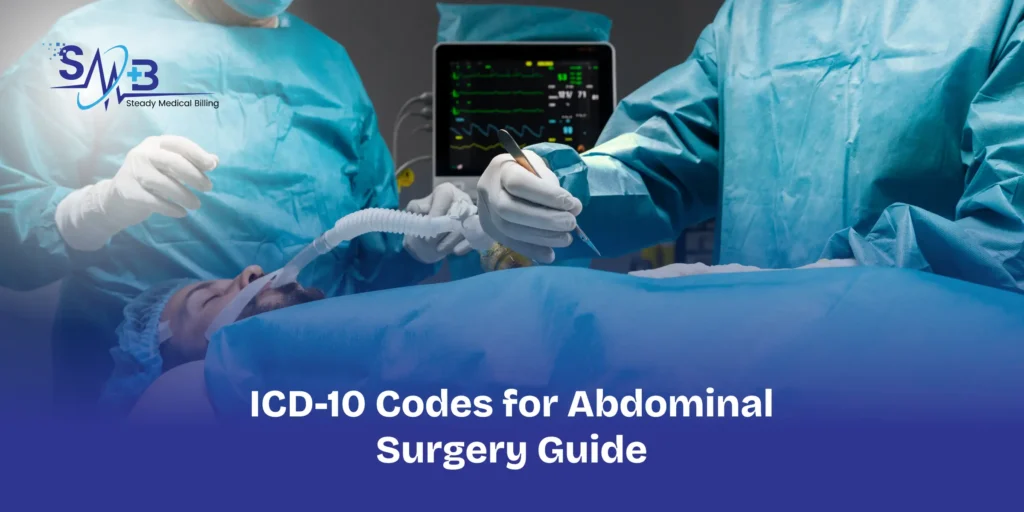
Abdominal surgery claims use three different code sets: ICD-10-CM explains why the surgery was needed, ICD-10-PCS reports the procedure on an inpatient hospital claim, and CPT reports the surgeon’s work on every claim, inpatient or outpatient.
Most coding errors on abdominal surgery claims happen because these systems get mixed up. A surgeon’s office puts a PCS code on a professional claim, a hospital coder picks the root operation Excision when the whole gallbladder came out, or a follow-up visit is billed with a diagnosis that no longer exists after surgery.
This guide covers the diagnosis codes that drive abdominal procedures (appendicitis, gallstones, hernias, colon disease), the ICD-10-PCS codes hospitals report for the same operations, the CPT codes surgeons bill, and how to code aftercare and postoperative complications. Every ICD-10-CM and ICD-10-PCS code below has been checked against the FY2027 code sets, in effect for discharges and dates of service from 1 October 2026.
Key Takeaways
- ICD-10-CM (diagnoses) goes on every claim. ICD-10-PCS (procedures) is used only on inpatient hospital claims. Surgeons and outpatient facilities report procedures with CPT.
- In ICD-10-PCS, removing an entire organ is Resection (0DT, 0FT), not Excision (0DB, 0FB). A laparoscopic approach is coded as Percutaneous Endoscopic (approach value 4).
- Code the diagnosis to the highest level of certainty. If the pathology or operative note confirms appendicitis or gallstones, do not code only the symptom.
- Routine postoperative follow-up uses aftercare codes such as Z48.815. A documented complication uses a complication code (K91.-, T81.-) instead.
- Most major abdominal CPT codes carry a 90-day global period, but the anterior abdominal hernia codes introduced in 2023 (49591 to 49618) carry a 0-day global.
ICD-10-CM vs ICD-10-PCS vs CPT: Which Code Set Goes Where
The ICD-10 system has two parts maintained by different agencies. CDC’s National Center for Health Statistics maintains ICD-10-CM for diagnoses, and CMS maintains ICD-10-PCS for inpatient hospital procedures. CPT, maintained by the AMA, is a separate system for physician and outpatient services. For a fuller primer on the three systems, see our guide to CPT, ICD-10 and HCPCS codes.
| Code set | What it describes | Who reports it | Example |
|---|---|---|---|
| ICD-10-CM | Diagnosis, the reason for surgery | Everyone: surgeon, hospital, ASC | K80.20 gallstones without cholecystitis |
| ICD-10-PCS | Procedure performed during an inpatient stay | Hospital, inpatient claim (837I) only | 0FT44ZZ laparoscopic gallbladder resection |
| CPT | Professional and outpatient procedures | Surgeon (837P); hospital outpatient and ASC | 47562 laparoscopic cholecystectomy |
Do not put an ICD-10-PCS code on a surgeon’s professional claim. Physicians bill CPT for the same operation even when the patient is an inpatient. PCS codes belong only on the hospital’s inpatient facility claim.
Common ICD-10-CM Diagnosis Codes for Abdominal Surgery
The diagnosis code is what establishes medical necessity. Payers compare it with the procedure code, and a mismatch is a common cause of CO-11 denials (diagnosis inconsistent with procedure). The codes below are billable in FY2027 unless marked as a category header.
Appendicitis (K35.-)
| Code | Official title |
|---|---|
| K35.80 | Unspecified acute appendicitis |
| K35.890 | Other acute appendicitis without perforation or gangrene |
| K35.30 | Acute appendicitis with localized peritonitis, without perforation or gangrene |
| K35.32 | Acute appendicitis with perforation, localized peritonitis, and gangrene, without abscess |
| K35.211 | Acute appendicitis with generalized peritonitis, with perforation and abscess |
K35, K35.2, K35.3, K35.8 and K35.89 are category or subcategory headers and cannot be billed. Read the operative note and pathology report for perforation, gangrene, abscess and peritonitis, because each changes the code.
Gallbladder disease (K80.-, K81.-)
| Code | Official title |
|---|---|
| K80.20 | Calculus of gallbladder without cholecystitis without obstruction |
| K80.00 | Calculus of gallbladder with acute cholecystitis without obstruction |
| K80.01 | Calculus of gallbladder with acute cholecystitis with obstruction |
| K81.0 | Acute cholecystitis (without gallstones) |
Hernias (K40 to K46)
| Code | Official title |
|---|---|
| K40.90 | Unilateral inguinal hernia, without obstruction or gangrene, not specified as recurrent |
| K40.20 | Bilateral inguinal hernia, without obstruction or gangrene, not specified as recurrent |
| K42.9 | Umbilical hernia without obstruction or gangrene |
| K43.2 | Incisional hernia without obstruction or gangrene |
| K43.9 | Ventral hernia without obstruction or gangrene |
Hernia codes split on laterality (inguinal), obstruction, gangrene and recurrence. A recurrent hernia has its own code, and the surgeon’s CPT code also changes for recurrent repairs, so both need to agree.
Colon and stomach conditions
| Code | Official title |
|---|---|
| K57.32 | Diverticulitis of large intestine without perforation or abscess without bleeding |
| K56.51 | Intestinal adhesions [bands], with partial obstruction |
| C18.9 | Malignant neoplasm of colon, unspecified |
| C16.0 | Malignant neoplasm of cardia |
In outpatient coding, do not code a condition described as probable, suspected or rule out. Code the symptom instead, such as R10.31 (right lower quadrant pain), until the diagnosis is confirmed. Once the operative or pathology findings confirm appendicitis, code the confirmed condition. Inpatient hospital coding follows a different rule for uncertain diagnoses at discharge.
ICD-10-PCS Codes for Common Abdominal Procedures
Every ICD-10-PCS code has seven characters: section, body system, root operation, body part, approach, device and qualifier. For abdominal surgery, the characters that cause the most errors are the root operation and the approach.
Resection vs Excision. Per the ICD-10-PCS Official Guidelines (B3.8), Resection is coded when all of a body part is cut out or off. Excision means only a portion was removed. A cholecystectomy removes the whole gallbladder, so it is Resection (0FT4), not Excision (0FB4).
Laparoscopic = Percutaneous Endoscopic. PCS has no laparoscopic approach. Laparoscopic and robotic-assisted procedures use approach value 4. An open procedure with laparoscopic assistance is coded Open (guideline B5.2a).
| Procedure | Open | Laparoscopic | Root operation |
|---|---|---|---|
| Appendectomy | 0DTJ0ZZ | 0DTJ4ZZ | Resection of appendix |
| Cholecystectomy | 0FT40ZZ | 0FT44ZZ | Resection of gallbladder |
| Right colectomy | 0DTF0ZZ | 0DTF4ZZ | Resection of right large intestine |
| Sigmoid colectomy | 0DTN0ZZ | 0DTN4ZZ | Resection of sigmoid colon |
| Total gastrectomy | 0DT60ZZ | 0DT64ZZ | Resection of stomach |
| Partial gastrectomy | 0DB60ZZ | 0DB64ZZ | Excision of stomach |
| Exploratory laparotomy | 0WJG0ZZ | 0WJG4ZZ | Inspection of peritoneal cavity |
| Peritoneal drainage | 0W9G0ZZ | 0W9G3ZZ (percutaneous) | Drainage; device value 0 (0W9G00Z) when a drain is left in place |
Hernia repairs use the anatomical-region body systems: inguinal regions are in 0YQ (Repair) or 0YU (Supplement), for example 0YQ54ZZ for a laparoscopic right inguinal repair, and the abdominal wall is 0WQF (Repair) or 0WUF (Supplement). When mesh is placed to reinforce the repair, the mesh is reported with the root operation Supplement and device value J (synthetic substitute), such as 0YU54JZ or 0WUF0JZ.
Do not code a converted procedure as if it were done open from the start. Under guideline B3.2d, when a laparoscopic cholecystectomy is converted to open, report Inspection with the percutaneous endoscopic approach plus Resection with the open approach (0FT40ZZ).
Remember also that inspection performed to complete a procedure is not coded separately (B3.11a). Do not add 0WJG4ZZ to a routine laparoscopic appendectomy.
CPT Codes Surgeons Bill for the Same Operations
The surgeon’s claim needs a CPT code, the ICD-10-CM diagnosis and the right modifiers. Approach changes the CPT code just as it changes the PCS code. Our 58571 total laparoscopic hysterectomy guide shows how approach and pathology findings change the CPT code in another abdominal specialty.
| Procedure | Common CPT codes | Notes |
|---|---|---|
| Appendectomy | 44950 open; 44960 open for ruptured appendix with abscess or generalized peritonitis; 44970 laparoscopic | The diagnosis should support 44960 when it is used |
| Cholecystectomy | 47562 laparoscopic; 47563 laparoscopic with cholangiography; 47600 open | Intraoperative cholangiography changes the code |
| Partial colectomy | 44140 open with anastomosis; 44204 laparoscopic with anastomosis | Colostomy and other variations have their own codes |
| Inguinal hernia | 49505 open initial, reducible, age 5 or older; 49650 laparoscopic initial | Initial vs recurrent and age drive code choice |
| Ventral, umbilical, incisional hernia | 49591 to 49596 initial; 49613 to 49618 recurrent | Based on total defect size and reducible vs incarcerated; mesh included |
| Exploratory laparotomy | 49000 | Not billed separately when it is the approach for a definitive procedure |
The American College of Surgeons notes that the 2023 anterior abdominal hernia codes include mesh implantation (old add-on 49568 was deleted), are selected by total defect size (under 3 cm, 3 to 10 cm, over 10 cm) and carry a 0-day global period. Removal of non-infected mesh is reported with add-on 49623. Bundling between a primary procedure and a lesser one is controlled by NCCI edits; see our guide to CO-97 bundling denials for how these get denied.
Aftercare, History and Complication Codes
After surgery, the condition that was removed usually no longer exists. Coding the follow-up visit correctly depends on whether the visit is routine aftercare or treatment of a complication.
| Code | Official title | When to use |
|---|---|---|
| Z48.815 | Encounter for surgical aftercare following surgery on the digestive system | Planned follow-up, such as wound checks or drain removal, after GI surgery |
| Z48.3 | Aftercare following surgery for neoplasm | Aftercare after a cancer resection; add the cancer code if still being treated |
| Z90.49 | Acquired absence of other specified parts of digestive tract | Status code for a removed digestive organ when relevant |
| Z87.19 | Personal history of other diseases of the digestive system | History of a resolved digestive condition |
| K91.89 | Other postprocedural complications and disorders of digestive system | A documented digestive complication with no more specific code |
| K91.840 | Postprocedural hemorrhage of a digestive system organ or structure following a digestive system procedure | Bleeding the surgeon documents as a complication |
| K91.86 | Retained cholelithiasis following cholecystectomy | Retained stones after gallbladder removal |
| K66.0 | Peritoneal adhesions (postprocedural) (postinfection) | Adhesions without obstruction |
| T81.31XA | Disruption of external operation (surgical) wound, not elsewhere classified, initial encounter | Wound dehiscence |
| T81.41XA | Infection following a procedure, superficial incisional surgical site, initial encounter | Superficial surgical site infection; T81.42- deep, T81.43- organ/space, T81.44- sepsis |
| G89.18 | Other acute postprocedural pain | Postoperative pain beyond what is expected, when documented as such |
Z48.81 itself is a subcategory header and is not billable; use the six-character code for the body system. T81.4XXA no longer exists: since FY2022 infection following a procedure must be coded by depth with T81.40 to T81.49.
Do not assign a complication code just because a problem appeared after surgery. ICD-10-CM guidelines require the provider to document the cause-and-effect relationship between the procedure and the condition. If the note is unclear, query the surgeon. Constipation from properly prescribed postoperative opioids, for example, is coded as a drug adverse effect (K59.03 plus the T40 code), as our constipation ICD-10 code guide explains.
For wound complications that need ongoing debridement or dressing care, our wound care billing guidelines explain how those services are billed.
Global Surgery Rules That Affect the Diagnosis
CMS’s Global Surgery Booklet explains that a major surgery’s payment includes the day-before visit, the operation and routine postoperative care during the global period, which is 90 days for most major abdominal procedures. Routine follow-up visits in that window are not paid separately; many practices track them with 99024. Services outside the package need a modifier and a supporting diagnosis:
- Modifier 24: unrelated E/M visit during the postoperative period, with a diagnosis that is clearly not the surgical condition.
- Modifier 78: unplanned return to the operating room for a related procedure, usually paired with a complication code such as K91.840 or T81.31XA.
- Modifier 79: unrelated procedure during the postoperative period, with its own diagnosis.
- Modifier 58: staged or planned related procedure, such as a planned second-look operation.
Worked Example: Laparoscopic Appendectomy, Inpatient
A patient is admitted through the emergency department with right lower quadrant pain. CT and surgical findings show acute appendicitis with localized peritonitis, no perforation and no gangrene. The surgeon performs a laparoscopic appendectomy, and the patient is discharged two days later.
| Claim | Diagnosis | Procedure |
|---|---|---|
| Hospital (837I) | K35.30 | ICD-10-PCS 0DTJ4ZZ |
| Surgeon (837P) | K35.30 | CPT 44970, place of service 21 |
| Post-op visit, day 12 | Z48.815 | 99024 (included in the global) |
| Wound dehiscence, day 20 | T81.31XA | E/M or repair CPT with modifier 78 if the patient returns to the OR |
R10.31 is not reported once appendicitis is confirmed, because the pain is a symptom routinely associated with the definitive diagnosis. Inpatient place of service rules for the surgeon are covered in our post on POS 21 billing.
Step-by-Step: Coding an Abdominal Surgery Encounter
- Identify the setting. Inpatient facility claims need ICD-10-PCS; professional and outpatient claims need CPT.
- Read the full operative note and pathology. Confirm what was removed, whether all or part of the organ came out, and any perforation, gangrene, abscess or obstruction.
- Confirm the approach. Open, laparoscopic or converted. For hernias, record the total defect size and whether the hernia was reducible or incarcerated.
- Select the most specific ICD-10-CM code. Use the confirmed diagnosis, not the presenting symptom, and check that the code is valid for the date of service.
- Check edits and modifiers. Run NCCI edits, confirm the global period, and add 24, 58, 78 or 79 when they apply.
- Query when documentation is unclear. Missing laterality, size or complication linkage should be clarified before the claim goes out.
Practices that want a second set of eyes on surgical coding can use a medical coding audit to find recurring errors, or hand coding to our certified medical coding team.
Billing appendectomies, cholecystectomies, colectomies and hernia repairs? Steady Medical Billing’s general surgery billing team codes from the operative note, tracks global periods and modifiers, and works surgical denials so your claims get paid.
Frequently Asked Questions
What is the difference between ICD-10-CM and ICD-10-PCS for abdominal surgery?
ICD-10-CM codes the diagnosis, such as appendicitis or gallstones, and is used on every claim. ICD-10-PCS codes the procedure itself and is used only on inpatient hospital claims. Surgeons report their procedures with CPT.
What is the ICD-10-PCS code for a laparoscopic cholecystectomy?
0FT44ZZ, Resection of Gallbladder, Percutaneous Endoscopic Approach. The open procedure is 0FT40ZZ. Because the whole gallbladder is removed, the root operation is Resection, not Excision.
Which ICD-10 code is used for aftercare after abdominal surgery?
Z48.815, Encounter for surgical aftercare following surgery on the digestive system, is used for routine follow-up after GI surgery. Use Z48.3 for aftercare after surgery for a neoplasm. If a complication is documented, code the complication instead.
Is T81.4XXA still a valid code for a postoperative infection?
No. Since FY2022, infection following a procedure is coded by depth: T81.41- superficial incisional, T81.42- deep incisional, T81.43- organ and space, T81.44- sepsis, and T81.40- unspecified, each with a 7th character.
Do surgeons use ICD-10-PCS codes on their claims?
No. Surgeons bill CPT codes on the professional claim, for example 44970 for a laparoscopic appendectomy, along with the ICD-10-CM diagnosis. ICD-10-PCS codes appear only on the hospital inpatient claim.