This MIPS reporting guide for physicians shows how to keep your 2026 score at 75 points or higher, because anything lower cuts your 2028 Medicare Part B payments by up to 9%.
For the 2026 performance year, MIPS-eligible clinicians need a final score of at least 75 points to avoid a negative payment adjustment. Below 75, CMS cuts 2028 Part B payments on a sliding scale, and any score of 18.75 or less gets the full −9%. You must submit 2026 data by March 31, 2027.
Most practices lose points for avoidable reasons. They pick quality measures that cannot score, miss a required attestation, or start tracking too late in the year. This guide covers the 2026 rules, the deadlines that remain, and the choices that move your score the most.
Small practices get special scoring rules, so this guide also includes a score estimator you can test with your own numbers.
Key Takeaways
- The 2026 performance threshold is 75 points. A score of exactly 75 earns a neutral adjustment in 2028.
- The negative scale runs from 0% at 75 points to −9% at zero. Any score of 18.75 or lower gets the full −9%.
- Standard weights are Quality 30%, Cost 30%, Promoting Interoperability 25% and Improvement Activities 15%. Reweighting changes them.
- Small practices (15 or fewer clinicians) get 6 bonus quality points, automatic PI reweighting and full Improvement Activities credit for one activity.
- A missing Security Risk Analysis or SAFER Guide attestation drops your whole PI score to zero.
- For 2026, the last day to start a 180-day PI period was July 5, and the last day to start a 90-day activity was October 3. Year-end work therefore centers on data completeness, attestations and exceptions.
What Is the MIPS Penalty for 2026?
CMS set the performance threshold at 75 points for the 2026 performance year in the CY 2026 Physician Fee Schedule final rule. The same threshold applies through the 2028 performance year. Your 2026 final score then sets a payment adjustment for covered professional services that Medicare pays in 2028.
| 2026 final score | 2028 payment adjustment |
|---|---|
| 0 to 18.75 | −9%, the statutory maximum |
| 18.76 to 74.99 | Negative, on a linear scale that reaches 0% at 75 points |
| 75.00 | 0% (neutral) |
| 75.01 to 100 | Positive, but CMS sets the size with a budget-neutral scaling factor |
The negative side follows simple arithmetic. CMS draws a straight line from 0% at 75 points down to −9% at zero points. Each point below 75 therefore costs about 0.12 percentage points. For example, a score of 60 produces an adjustment of roughly −1.8%.
Watch for calculators that start the scale at 18.75 points. That shortcut overstates the penalty. The regulation anchors the line at zero. It then applies the full −9% to every score at or below one quarter of the threshold.
The positive side is less predictable. Because MIPS is budget neutral, penalties fund the increases. CMS multiplies positive adjustments by a scaling factor of up to 3.0, so nobody knows the 2028 bonus size until scoring ends. In addition, the separate bonus for exceptional performance no longer exists. It ended after the 2022 performance year.
Performance Year Versus Payment Year
Many articles about the “2026 MIPS penalty” actually describe 2026 payments, which reflect 2024 scores. This guide covers the 2026 performance year. You collect data from January 1 to December 31, 2026, submit it in early 2027, and feel the result on 2028 claims.
Who Must Report MIPS in 2026?
MIPS applies to physicians, nurse practitioners, physician assistants, clinical nurse specialists, certified registered nurse anesthetists and several other clinician types. However, you must report only if you exceed the low-volume threshold. To exceed it, you need all three of the following:
- Over $90,000 in allowed charges for covered professional services under Medicare Part B
- More than 200 Medicare Part B patients
- Above 200 covered professional services furnished to Medicare Part B patients
CMS measures these figures across two 12-month segments. For 2026, the first runs from October 1, 2024 to September 30, 2025. The second runs from October 1, 2025 to September 30, 2026. If you fall below the threshold in the first segment, you stay excluded for the year.
Two other groups are excluded. Clinicians who first enrolled in Medicare during 2026 and never billed Medicare before do not report. Qualifying APM Participants are also exempt. Meanwhile, clinicians who exceed one or two criteria, but not all three, may opt in.
Check every clinician at both levels. Eligibility can differ for an individual and for the group under the same Taxpayer Identification Number (TIN). Look up each NPI in the QPP Participation Status tool before you choose a reporting level.
What Are the Four MIPS Performance Categories in 2026?
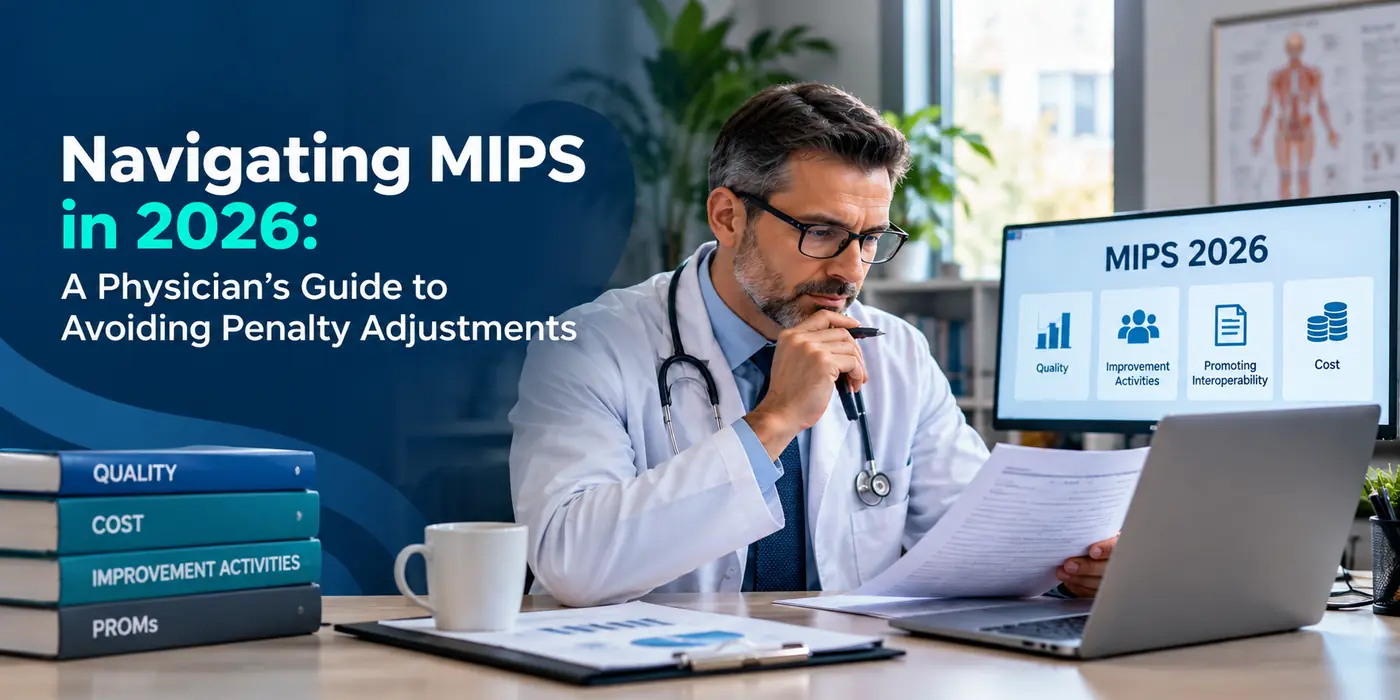
Your final score combines four categories. Each has its own weight, performance period and reporting task.
| Category | Weight | Performance period | What you do | Notable for 2026 |
|---|---|---|---|---|
| Quality | 30% | Full calendar year | Report 6 measures, including 1 outcome or high-priority measure | 190 measures (187 in traditional MIPS); 75% data completeness |
| Cost | 30% | Full calendar year | Nothing to submit; CMS calculates it from claims | 35 cost measures, unchanged from 2025; any new measure is feedback-only for 2 years |
| Promoting Interoperability | 25% | At least 180 consecutive days | Report measures and attestations from certified EHR technology | Security Risk Analysis needs 2 attestations; 2025 SAFER Guide |
| Improvement Activities | 15% | At least 90 consecutive days per activity | Attest to 2 activities, or 1 if small, rural, HPSA or non-patient-facing | 3 activities added, 8 removed, 1 new subcategory |
The CMS 2026 QPP final rule fact sheet lists every measure and activity change.
How Reweighting Changes the Math
CMS moves a category’s weight elsewhere when it cannot score that category. For instance, a small practice that skips PI, or a clinician with too few patients for any cost measure, ends up with different weights.
| Scenario | Quality | Cost | IA | PI |
|---|---|---|---|---|
| All four categories scored | 30% | 30% | 15% | 25% |
| PI not scored (most clinicians) | 55% | 30% | 15% | 0% |
| PI not scored (small practice) | 40% | 30% | 30% | 0% |
| Cost not scored | 55% | 0% | 15% | 30% |
| Neither Cost nor PI scored (most clinicians) | 85% | 0% | 15% | 0% |
| Neither Cost nor PI scored (small practice) | 50% | 0% | 50% | 0% |
These weights come from the scoring rules in 42 CFR Part 414, Subpart O. If CMS can score fewer than two categories, your final score defaults to 75, which means a neutral adjustment.
MIPS Reporting Guide for Physicians: What You Can Still Do Before December 31
Timing now limits your options. A 180-day PI period had to start by July 5, 2026. Similarly, a new 90-day Improvement Activity had to start by October 3, 2026. Still, several high-value tasks remain open until the year closes.
| Date | What happens | Your action |
|---|---|---|
| July 5, 2026 | Last start date for a 180-day PI period (passed) | Confirm your PI dates; if you cannot cover 180 days and no automatic reweighting applies, review the hardship exception |
| October 3, 2026 | Last start date for a new 90-day activity (passed) | Document any activity you already completed earlier in 2026 |
| November 30, 2026 | MVP and subgroup registration closes at 8 p.m. ET | Register only if you plan to report an MVP |
| December 31, 2026 | Performance year ends; PI hardship and Extreme and Uncontrollable Circumstances applications close at 8 p.m. ET | Finish the Security Risk Analysis and SAFER Guide review; file any exception |
| March 31, 2027 | Submission deadline for 2026 data | Submit, then confirm CMS received every category |
| January to December 2028 | Your adjustment applies to Part B claims | Budget for the result |
CMS’s 2026 registration and exception application guides set both 8 p.m. ET cutoffs. You file exceptions on the QPP exception applications page, so apply well before the last day.
Year-End Steps for the Remaining Weeks
Work through these steps in order:
- Confirm status. Recheck each NPI and the TIN, because the second determination segment closed on September 30, 2026.
- Run a data completeness check. Compare each quality measure’s denominator with your encounter list, then close gaps while records are fresh.
- Finish the PI attestations. You must complete the Security Risk Analysis and the SAFER Guide review during 2026, so schedule both now.
- Collect activity evidence. An Improvement Activity counts for any continuous 90 days in 2026, so an activity you ran in spring may still qualify.
- Choose your submission route. Decide on individual or group reporting, then confirm your registry, EHR or claims workflow can meet the March 31 deadline.
Quality Measure Selection for Medicare: Choose Measures That Score
Quality carries the largest controllable weight, so measure choice matters. In traditional MIPS, you report six measures, including at least one outcome measure. If no outcome measure applies, a high-priority measure can fill that slot. Alternatively, you can report a specialty measure set.
How a Measure Earns Points
Each measure earns 1 to 10 achievement points, based on where your performance falls against the national benchmark deciles. To earn those points, a measure needs a benchmark, enough cases to meet its case minimum, and complete data.
In most cases, a measure that misses these tests earns 0 points. Small practices instead receive 3 points for such a measure. Some topped-out measures also cap at 7 points, so a perfect rate there cannot reach 10.
The 75% Data Completeness Rule
For 2026, you must report on at least 75% of the patients who meet each measure’s denominator. With eCQMs, MIPS CQMs and QCDR measures, that count includes all payers. Claims measures instead cover 75% of your Medicare Part B patients, and only small practices may use claims reporting.
A Practical Selection Checklist
- The measure fits your specialty and your actual patient mix.
- You see enough eligible patients to meet the case minimum.
- A 2026 benchmark exists, and your current rate sits in a scoring decile you can defend.
- Your EHR or registry captures the numerator, denominator and exclusions without manual workarounds.
- At least one measure is an outcome or high-priority measure.
- You avoid relying heavily on capped topped-out measures.
Never add codes or documentation just to improve a measure rate. Every numerator and exclusion must reflect care the patient actually received.
Promoting Interoperability Reporting for Doctors
Promoting Interoperability (PI) counts for 25% of the score. You need at least 180 consecutive days of data from certified EHR technology. You report four objectives: electronic prescribing (including the prescription drug monitoring program query), health information exchange, provider-to-patient exchange, and public health and clinical data exchange.
For each required measure, you report a numerator of at least one or claim an available exclusion. A missing required measure leaves you with no PI score.
Three Attestations That Can Zero Out the Category
Security Risk Analysis. For 2026, CMS requires two “Yes” answers. You attest that you conducted or reviewed a security risk analysis, and that you implemented risk management measures under the HIPAA Security Rule.
High Priority Practices SAFER Guide. You must attest “Yes” to completing the annual self-assessment. For 2026, you must use the High Priority Practices Guide from the 2025 SAFER Guides.
Interoperability and ONC attestations. You also confirm that you did not knowingly limit your certified EHR’s interoperability, and that you will cooperate with ONC direct review.
A “No” on either of the first two measures gives you zero for the whole category. Similarly, you need every required attestation, plus your EHR’s CMS certification ID, to earn any PI score. On the upside, CMS added an optional public health bonus measure that uses TEFCA, and PI bonus points cap at five in total.
Who Gets Automatic PI Reweighting
Small practices, hospital-based clinicians, ASC-based clinicians and non-patient-facing clinicians receive automatic reweighting. However, if you submit PI data anyway, CMS scores it. In contrast, nurse practitioners, physician assistants, clinical nurse specialists and CRNAs lost their automatic reweighting after the 2022 performance year. Other clinicians can apply for a hardship exception by the December 31 deadline.
Improvement Activities: The Points You Control
Improvement Activities (IA) are the most predictable points in MIPS. Most clinicians attest to two activities. Clinicians in small practices, rural areas or health professional shortage areas, and non-patient-facing clinicians, need only one.
CMS removed activity weighting starting with 2025. Each activity now earns 20 points, or 40 points for the groups above, and 40 points fills the category. Therefore one activity gives a small practice full IA credit.
- Perform each activity for at least 90 consecutive days during 2026.
- In a group, at least half of the clinicians must perform the same activity, each for a continuous 90 days within 2026.
- MVP reporters attest to one activity regardless of status.
- Keep dated evidence, such as protocols, logs and reports, for each activity.
The 2026 inventory adds a new Advancing Health and Wellness subcategory. It also adds three activities, including one on patient safety in the use of artificial intelligence.
MIPS Score Optimization for Small Practices
CMS defines a small practice as a TIN with 15 or fewer eligible clinicians during the determination period. That status unlocks several scoring advantages:
Automatic PI reweighting. If you do not submit PI data, your weights shift to Quality 40%, Cost 30% and IA 30%.
One activity fills IA. Because a single activity earns 40 points, IA can supply 30 points of your final score, or 50 points when Cost is also unscored.
6 bonus quality points. CMS adds them to the Quality category when you submit at least one quality measure.
A 3-point floor. Measures that miss data completeness, the case minimum or a benchmark still earn 3 points instead of zero.
Claims reporting. You may report quality through Medicare Part B claims, which helps practices without a registry.
Worked Examples
The table below shows hypothetical practices, not real clients. Quality uses six measures, so 60 achievement points is the maximum. The examples leave out the complex patient bonus and improvement scoring.
| Scenario | Inputs | Weights (Q/C/IA/PI) | Final score | 2028 adjustment |
|---|---|---|---|---|
| A. Small practice, Cost not scored | Quality 30 of 60 points plus 6 bonus = 60%; 1 activity; no PI | 50/0/50/0 | 80.0 | Positive (size set by scaling) |
| B. Small practice, Cost scored | Same as A; Cost 50% | 40/30/30/0 | 69.0 | About −0.72% |
| C. Larger group, all four scored | Quality 60%; Cost 50%; 2 activities; PI 80% | 30/30/15/25 | 68.0 | About −0.84% |
| D. Larger group, failed PI attestation | Same as C, but PI scores 0 | 30/30/15/25 | 48.0 | About −3.24% |
Scenario B shows why Cost matters even though you submit nothing for it. Scenario D shows how one missed attestation costs 20 points.
Estimate Your 2026 Final Score
Estimate only. This tool applies the 2026 traditional MIPS weights and payment formula. It does not model improvement scoring, the complex patient bonus or facility-based scoring, and CMS calculates your official score.
Weights used: Quality 50%, Cost 0%, IA 50%, PI 0%
Estimated final score: 80.00 (5.00 points above the threshold)
Estimated 2028 adjustment: Positive. CMS sets the size with a budget-neutral scaling factor after scoring.
Building a MIPS Performance Category Strategy
A sound MIPS performance category strategy starts with control. You fully control IA and the PI attestations. You partly control Quality through measure choice and documentation. Cost moves slowly and depends on attribution, so plan around it rather than on it.
Pick the Reporting Level Deliberately
When you report as a group, every clinician under the TIN receives the group’s final score, whether it helps or hurts. Group reporting suits practices with shared workflows and similar performance. On the other hand, individual reporting can protect a strong performer in a practice with uneven results.
Small-practice status comes from the size of the TIN, not from the reporting level. As a result, the 6 bonus points, the 3-point floor, one-activity IA credit and automatic PI reweighting apply whether you report as individuals or as a group.
Multispecialty groups face a new MVP rule in 2026. If they report an MVP, they must register as subgroups, as individuals or as an APM Entity. Multispecialty small practices are the exception and can still report an MVP as a group. Separately, solo practitioners and groups of 10 or fewer can form a virtual group for 2027 if they elect by December 31, 2026.
Set a Review Cadence
- Monthly: review measure performance rates, data completeness and unclosed care gaps.
- Quarterly: re-score the practice with current numbers and adjust measure choices early.
- By year-end: complete the attestations, gather activity evidence and file any exceptions.
- Before submission: reconcile registry or EHR files against source records.
Name one owner for each category. In a small practice, one person may own several categories, but every task still needs a name and a due date.
How Billing, Coding and Documentation Feed Your Score
MIPS uses the same data your revenue cycle produces. CMS builds Cost scores from Medicare claims. Measures such as Total Per Capita Cost also adjust for patient risk using diagnosis data. As a result, incomplete diagnosis coding can make your patients look healthier than they are, so their care looks costlier by comparison.
Quality depends on documentation too. A missed exclusion or an unrecorded result can turn a met measure into a failed one. Strong clinical documentation improvement closes these gaps at the point of care rather than at submission.
Claims reporters face a tighter loop. Quality data codes must ride on the original claim, and CMS counts only claims it processes within 60 days after the year ends. In this case, accurate medical coding services protect both payment and measure credit.
Finally, EHR reports are not automatically correct. Compare measure output with a sample of charts each quarter, because mapping errors often stay hidden until submission.
Why MIPS Tracking Protects Your Medicare Revenue
A MIPS adjustment applies to every covered professional service Medicare pays for during the year. Consider a hypothetical practice that expects $400,000 in 2028 Part B payments under the physician fee schedule:
- Scoring 60 means about −1.8%, or roughly $7,200.
- At 48, as in Scenario D above, the cut is about −3.24%, or roughly $12,960.
- Any score of 18.75 or lower means −9%, or $36,000.
Meanwhile, the positive side stays modest and uncertain. For most practices, the real goal is to stay at or above 75 every year. Year-round tracking turns that goal into routine work instead of a March emergency.
For outside support, MIPS reporting services can monitor measures, check data completeness and prepare submissions alongside your billing.
CMS proposed the CY 2027 rule in July 2026, and it targets the 2027 performance year. Until CMS finalizes it, plan your 2026 submission on the rules above.
Want a second set of eyes on your 2026 data before the March 31 deadline? Explore Steady Medical Billing’s MIPS reporting services.
Frequently Asked Questions
What is the MIPS penalty for 2026?
For the 2026 performance year, a final score below 75 points triggers a negative adjustment on 2028 Medicare Part B payments. The cut grows on a linear scale as the score falls, and any score of 18.75 or below gets the maximum −9%.
What are the MIPS measures for 2026?
The 2026 inventory includes 190 quality measures, 35 cost measures, the Improvement Activities inventory and the PI objectives. Search them by specialty in the measure tools on the Quality Payment Program website.
What are the four performance categories included in MIPS?
They are Quality, Cost, Promoting Interoperability and Improvement Activities. Their standard 2026 weights are 30%, 30%, 25% and 15%, although reweighting can change them.
What is a MIPS adjustment?
It is a positive, neutral or negative percentage that Medicare applies to payments for covered professional services two years after the performance year. It depends on how your final score compares with the 75-point threshold.
Is it too late to improve my 2026 MIPS score?
No. You can still close data completeness gaps, complete the Security Risk Analysis and SAFER Guide review, document activities you already performed and file any exception by December 31, 2026. However, the last start dates for a 2026 PI period (July 5) and a new 90-day activity (October 3) have passed.
Do nurse practitioners and physician assistants have to report Promoting Interoperability?
Yes, unless another exception applies, such as small practice status or a hospital-based designation. Their automatic PI reweighting ended after the 2022 performance year.
Is MIPS going away?
Not yet. CMS says it intends to sunset traditional MIPS in favor of MVPs, but it has not set a date. That change would need future rulemaking.