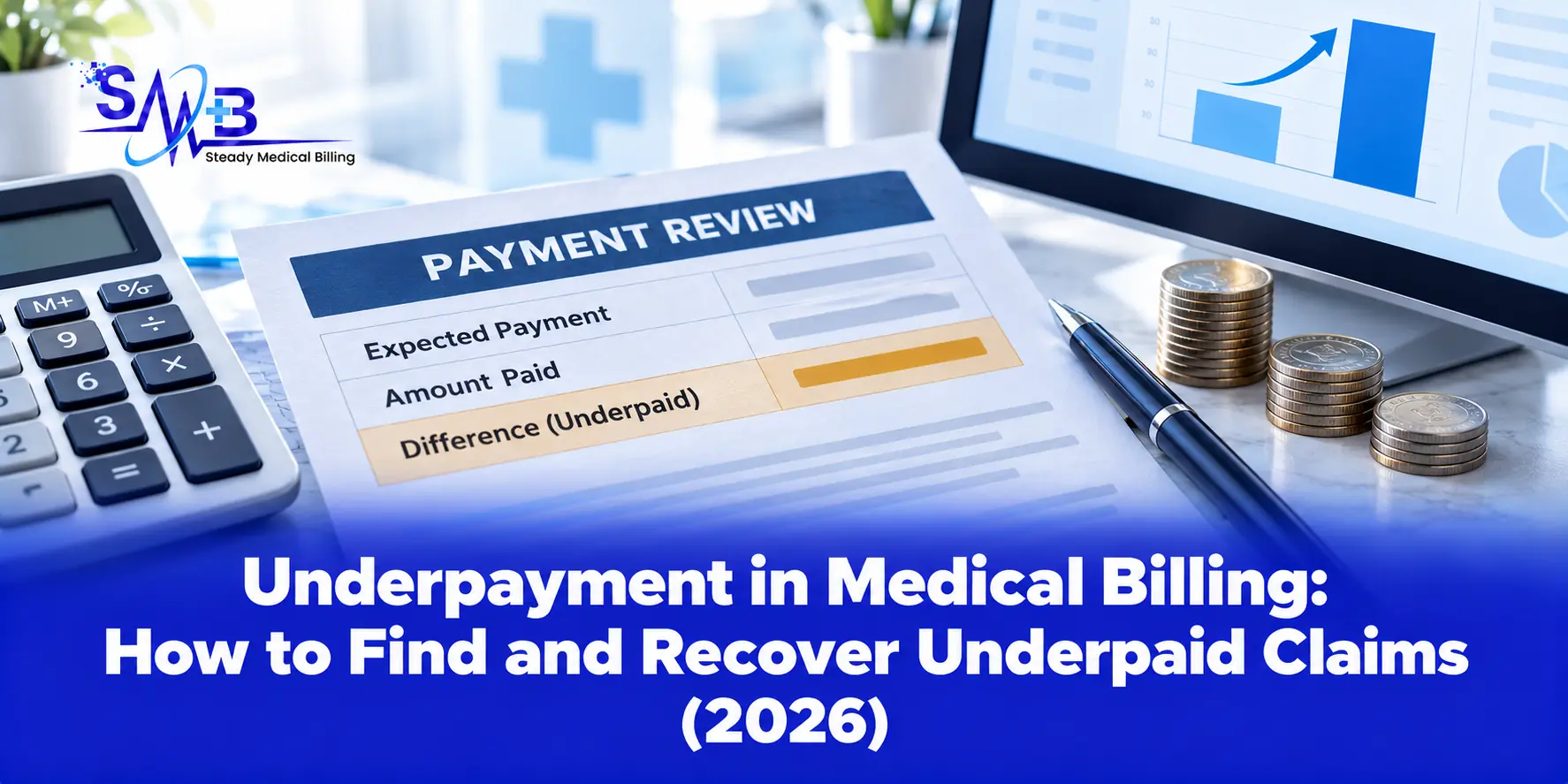
An underpayment in medical billing is when a payer pays a claim, but for less than your contract, fee schedule or the law says it owes. Unlike a denial, the claim looks “paid,” so the shortfall usually gets posted as a contractual adjustment and written off. To recover it, compare every allowed amount with the contracted rate, group the variances by payer and cause, and file a payment dispute or appeal with the contract language attached before the payer’s deadline.
Underpayments are easy to miss because nothing on the remittance looks wrong. The claim status says paid, the adjustment carries an ordinary code like CO-45, and the balance drops to zero. Across thousands of claims, a few dollars per line adds up to real lost revenue. This guide shows how to find underpaid claims, the most common causes, how to appeal them, and when it makes sense to bring in a recovery team.
Key Takeaways
- An underpayment is a claim paid below the contracted or legally required amount. A denial is a claim that isn’t paid at all.
- You can only find underpayments if your contracted fee schedules are loaded and checked against each 835 remittance.
- The usual causes are outdated fee schedules, incorrect modifier or multiple-procedure reductions, wrong place-of-service rates, missed carve-outs, and unauthorized network discounts.
- Appeal with evidence: the claim, the remittance, the contract section or fee schedule, and your own calculation of the amount owed.
- Check the deadline in each contract. Payment dispute windows are often 90 to 180 days from the remittance date, and some are shorter.
Underpayment vs Denial vs Contractual Adjustment
| Term | What happened | What to do |
|---|---|---|
| Denial | The payer refused to pay the claim or line | Correct and resubmit, or appeal. See our denial management guide |
| Contractual adjustment | The legitimate difference between your charge and the contracted allowed amount | Write it off. It is not owed. See contractual adjustments explained |
| Underpayment | The payer allowed or paid less than the contract requires | Dispute the variance and recover the difference |
Common Causes of Underpaid Claims
Outdated or wrong fee schedule. The payer didn’t load your contract’s annual update, or priced the claim on last year’s Medicare-based rates when your contract pays a percentage of the current year.
Incorrect multiple-procedure or modifier reductions. Reductions are applied to the wrong line, applied to a procedure that is exempt, or applied twice. These often show up as CARC 59 (“processed based on multiple or concurrent procedure rules”).
Wrong place-of-service or provider rate. An office visit is paid at the facility rate, or a physician service is paid at the lower rate set for a nurse practitioner or physician assistant.
Missed carve-outs and add-ons. Drugs, implants or high-cost supplies that the contract pays separately get bundled into the procedure payment.
Drug pricing errors. Specialty infusions are paid on the wrong unit count, a stale ASP quarter, or the wrong basis (ASP vs AWP), so the drug line is short even though the administration code is paid correctly.
Unauthorized network discounts. A claim is repriced through a rental or “silent” PPO network you never agreed to. This often appears with CARC 131 (claim-specific negotiated discount) or a remark naming a repricing company.
Partial payment hidden in the adjustment. The shortfall is posted under CO-45 (charge exceeds fee schedule) and written off as if it were a normal contractual adjustment.
How to Find Underpaid Claims
- Load your contracts. Enter every payer’s fee schedule, rate basis (for example 110% of the current Medicare fee schedule), carve-outs and effective dates into your practice management system or a contract management tool.
- Compare expected vs allowed on every 835. For each paid line, calculate the expected allowed amount and compare it with what the payer allowed. Flag any line below expected by more than a small tolerance.
- Group variances by payer, code and cause. One wrong rate usually affects hundreds of claims. Grouping turns many small variances into one dispute with a large dollar value.
- Review adjustment codes. Pull every CO-45, CO-59 and CO-131 adjustment and check whether the amount matches the contract.
- Check patient responsibility. If the payer shifted part of the allowed amount to the patient incorrectly, both the payment and the patient bill are wrong.
- Track it monthly. Report underpaid dollars identified, disputed and recovered by payer. A rising trend for one payer is often a system loading error you can fix at the source.
Accurate payment posting is the foundation. If payments and adjustments are posted in bulk without line-level detail, underpayments disappear. See how inaccurate payment posting warps practice financials.
How to Appeal an Underpaid Claim
- Confirm the variance. Recalculate the expected payment from the contract, including any multiple-procedure, modifier or sequestration reductions that legitimately apply.
- Use the payer’s dispute channel. Most commercial payers have a provider payment dispute or reconsideration process, often through their portal. Use it instead of submitting a corrected claim, unless your coding was actually wrong.
- Attach the evidence. Include the claim, the remittance, the contract section or fee schedule page, and a short calculation showing contracted rate, amount paid and amount owed.
- Batch similar claims. When the same rate error affects many claims, ask the payer to reprocess all of them as a project instead of appealing one by one.
- Escalate. If reconsideration fails, escalate to your provider relations or network representative, follow the contract’s dispute resolution clause, and consider a complaint to the state insurance department if your state’s prompt-pay rules apply.
- Fix the root cause. Ask the payer to correct the fee schedule loading so the same claims aren’t underpaid next month.
Appealing underpaid specialty infusion claims
For infusion drugs, check three things before you appeal: the number of billing units (the HCPCS unit size vs the dose given), the pricing basis and quarter the contract specifies, and whether the NDC on the claim matches the vial actually used. Send the appeal with the drug administration record, the NDC and units, and the contract’s drug pricing clause. For Medicare Part B, payment for most drugs is based on the current quarter’s Average Sales Price (ASP) file published by CMS.
Out-of-network claims priced without a contract
If a claim was repriced by a third party you never contracted with, ask the payer to identify the network agreement it relied on. For emergency services and certain out-of-network care at in-network facilities, the federal No Surprises Act limits balance billing and sets an open negotiation and independent dispute resolution (IDR) process, with strict timelines, for payment disputes.
In-House Recovery vs a Professional Recovery Team
An in-house team can recover underpayments if it has the contracts loaded, a variance report, and the time to work disputes. Most small and mid-sized practices don’t. Their staff are busy with new claims and denials, and underpayments are low priority because each one is small. A recovery team brings contract-modeling software, payer-specific dispute experience and dedicated follow-up. It’s often paid on contingency, so you pay only on what’s recovered. The right choice depends on your claim volume, number of contracts and staff capacity.
Not sure how much you’re being underpaid? Steady Medical Billing will compare a sample of your remittances against your payer contracts and show you the variance by payer. Learn about our underpayment recovery services.
Frequently Asked Questions
What is underpayment in medical billing?
An underpayment is when a payer pays a claim but for less than the amount required by your contract, its fee schedule or applicable law. The claim shows as paid, so the shortfall is often written off as a contractual adjustment unless someone compares the payment with the contracted rate.
How do you find underpaid claims?
Load each payer’s contracted fee schedule and rate rules, then compare the expected allowed amount with the allowed amount on every 835 remittance. Flag lines below expected, group them by payer, code and cause, and review CO-45, CO-59 and CO-131 adjustments for amounts that don’t match the contract.
How do you appeal an underpaid claim?
Recalculate the amount owed from the contract, then file a payment dispute or reconsideration through the payer’s provider channel. Attach the claim, remittance, the relevant contract or fee schedule page and your calculation. Batch claims with the same error and escalate to provider relations if the first review fails.
How long do I have to dispute an underpayment?
It depends on your contract and the payer. Many commercial contracts allow 90 to 180 days from the remittance date, but some are shorter, so check each agreement. Medicare redeterminations must be filed within 120 days of the initial determination.
What is the appeals process for underpaid specialty infusion claims?
Verify billing units, NDC and the drug pricing basis and quarter in your contract, then file a payment dispute with the administration record, NDC, units and the contract’s drug pricing clause. If the payer applied the wrong ASP quarter or unit conversion, ask for reprocessing of all affected claims.
Is professional underpayment recovery more effective than doing it in-house?
It can be when your team lacks loaded contracts, variance reporting or time to work disputes. Recovery firms use contract-modeling tools and dedicated follow-up and are often paid on contingency. Practices with strong in-house contract management can recover underpayments themselves.