
An RPM program can bill correctly for months and still lose the revenue to a single repeated documentation gap.
Remote patient monitoring billing compliance decides whether that recurring non-visit revenue stays in your practice or comes back out through denials, audits and payer clawbacks. Four things determine it: patient consent records, medical necessity documentation, qualifying device transmissions, and treatment management logs.
The 2026 coding changes add a further decision. Practices must now separate shorter monitoring periods from the traditional 16-day requirement, and bill the matching code for each.
This article covers what Medicare requires, which code applies when, the errors that trigger recoupment, and what to do if an audit letter arrives.
Key Takeaways
- Medicare RPM reimbursement depends on documented medical necessity, patient consent, eligible devices, and code-specific billing requirements.
- The 2026 codes add billing options for 2–15 days of device data and for shorter treatment management periods.
- Device-supply codes and treatment-management codes have separate thresholds — the day requirement does not apply to treatment management.
- Several 2026 codes are mutually exclusive. Billing two of them for the same month creates an unsupported claim.
- Only one practitioner may bill remote monitoring for a patient in a 30-day period.
- Monthly documentation reviews catch the errors that otherwise surface as repayment demands.
Why Remote Patient Monitoring Billing Compliance Matters for Physicians
Remote Patient Monitoring lets physicians track patients between office visits using connected medical devices. For practices managing hypertension, diabetes, heart failure and other chronic conditions, it supports earlier clinical intervention and creates a recurring reimbursement stream.
Enrolling more patients does not by itself produce more revenue.
Every RPM claim must meet specific billing and documentation requirements. A patient may use a connected blood pressure monitor all month without every RPM service that month qualifying for payment.
Common operational gaps include missing consent records, insufficient transmitted readings, inaccurate treatment management logs, and claims submitted under the wrong CPT code. These produce rejected claims, delayed reimbursement, or overpayments the payer later recovers.
A sustainable RPM program needs reliable processes for tracking monitoring activity, documenting clinical services, and validating claims before submission — not just enrollment and device distribution.
RPM Billing Guidelines for Physicians: What Medicare Requires
Patient Consent, Medical Necessity, and Device Eligibility
Per CMS Telehealth and Remote Monitoring guidance, Medicare RPM services must satisfy these conditions:
- Established patient relationship. RPM requires an established relationship between patient and billing practitioner. Note this applies to RPM but not to remote therapeutic monitoring.
- Medical necessity. Monitoring must be reasonable and necessary for an acute or chronic condition.
- Patient consent. CMS requires consent at the time RPM services are provided. Retain evidence of it.
- Qualifying devices. Devices must meet the FDA definition of a medical device and transmit physiological data automatically and electronically.
- Authorized billing practitioner. Services must be billed by an eligible physician or qualified practitioner.
- One practitioner per 30 days. CMS permits only one practitioner to bill remote monitoring for a given patient in a 30-day period.
Also document patient education, device setup, monitoring activity, and clinical decisions made in response to the data.
For a hypertension patient, the record should establish why remote blood pressure monitoring is appropriate, contain the consent, and evidence the services billed. Without that, clinically useful monitoring can still be indefensible on review.
The 16 Days of Readings Requirement and What Changed in 2026
The 16-day requirement has been a persistent source of billing confusion.
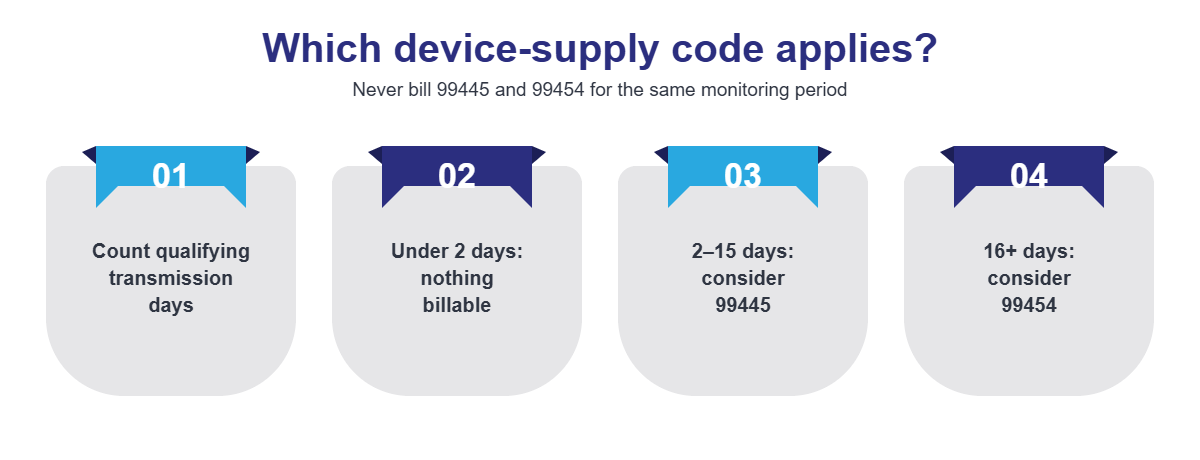
Under the 2026 structure, Medicare recognizes two device-transmission periods. CMS describes the split as 2–15 days or 16 or more days within a 30-day period.
Never bill these two codes together for the same monitoring period. Count the qualifying transmission days first, then select the code.
If a patient transmits readings on 12 qualifying days, they do not meet the threshold for the 16-day code — but the shorter-duration code may apply if the remaining requirements are met.
The day threshold applies only to device-supply billing. CMS states explicitly that the day-of-data requirement does not apply to treatment management codes, which carry their own time and communication requirements. Confusing the two is one of the most common sources of unsupported claims.
Verify the actual number of qualifying transmission days each month rather than defaulting to the 16-day code for every enrolled patient.
RPM CPT Codes for Data Transmission and Treatment Management
Medicare recognizes three distinct kinds of RPM service: device setup, device supply and data transmission, and clinical treatment management. Separating them is what keeps claims defensible.
Device-supply codes — based on transmission days
| CPT | Service | Requirement | Cannot be billed with |
|---|---|---|---|
| 99453 | Initial device setup and patient education | One-time, per episode of monitoring | — |
| 99445 | Device supply and data transmission | 2–15 qualifying days per 30-day period | 99454, same period |
| 99454 | Device supply and data transmission | 16 or more qualifying days per 30-day period | 99445, same period |
Treatment-management codes — based on time
| CPT | Service | Requirement | Cannot be billed with |
|---|---|---|---|
| 99470 | RPM treatment management, shorter increment | Shorter monthly increment; requires interactive communication | 99457, 99458, same month |
| 99457 | RPM treatment management | First 20 minutes per calendar month; requires interactive communication | 99470, same month |
| 99458 | Additional treatment management | Each additional 20 minutes beyond 99457 | 99470, same month |
| 99091 | Collection and interpretation of physiological data | At least 30 minutes of qualifying professional time per 30-day period | — |
Always confirm code descriptors and thresholds against the current AMA CPT code set before billing. Descriptors for the 2026 additions are new, and summaries of them vary between sources. For reimbursement amounts, use the CMS Physician Fee Schedule Look-Up Tool for your own locality — national averages will overstate or understate what your practice actually receives.
The 2026 additions let practices report shorter monitoring and management periods that previously fell below the traditional thresholds — work that was being delivered and written off.
Understanding CPT 99457 Billing Guidelines
CPT 99457 requires at least 20 minutes of qualifying clinical staff, physician or other qualified professional time during a calendar month, plus interactive communication with the patient or caregiver.
Qualifying activities include reviewing monitoring trends, evaluating changes in the patient’s condition, coordinating care, and adjusting treatment plans.
Receiving device readings does not by itself establish eligibility. Your documentation must support the time spent, the clinical services performed, and the interactive communication. Time counted toward another billed service cannot be counted again here.
For practices running broader virtual care, aligning RPM coding with telehealth billing services reduces inconsistency across remote care programs.
RPM or RTM: Which Applies to Your Patient
Remote physiologic monitoring and remote therapeutic monitoring are separate code families with different rules, and the choice is made before any claim is submitted. They cannot both be billed for the same patient concurrently.
| Remote physiologic monitoring (RPM) | Remote therapeutic monitoring (RTM) | |
|---|---|---|
| What is monitored | Physiologic data — blood pressure, weight, glucose, oxygen saturation | Therapeutic data — musculoskeletal and respiratory system status, medication and therapy adherence and response |
| Established patient relationship | Required | Not required |
| Typical users | Primary care, cardiology, endocrinology, nephrology, pulmonology | Physical and occupational therapy, pulmonary rehab, behavioral health |
| Data source | Device transmits automatically | May include patient-reported data |
CMS also updated RTM codes for 2026. If your practice delivers both kinds of monitoring, confirm which family applies per patient before enrolling them, not at the point of billing.
Common RPM Billing Errors That Put Medicare Reimbursement at Risk
Established programs lose reimbursement to preventable documentation and coding mistakes more often than to complex policy questions.
Missing consent and incomplete patient records
If you cannot produce evidence of consent, the patient’s monitoring need, or the services delivered, the payer may question whether the claim qualifies.
Keep this in an accessible clinical record — not scattered across device platforms, spreadsheets and staff messages. Records that exist but cannot be retrieved on request function as records that do not exist.
Incorrect transmission-day counts
The most common operational error is assuming enrollment equals billable monitoring.
Submitting the 16-day code when a patient has 10 qualifying transmission days creates an unsupported claim. Since 2026, the shorter-duration code may apply instead — which means this error now costs you revenue as well as exposing you to recoupment, because the correct claim was available and not made.
Billing mutually exclusive codes together
The 2026 codes introduced pairs that cannot be reported for the same period. Billing both the short-duration and 16-day device-supply codes for one monitoring period, or stacking treatment-management codes that replace rather than supplement each other, produces claims that will not survive review.
This is the error most likely to follow from reading a code list without the exclusivity rules attached.
Unsupported treatment-management time
Recording 20 minutes without supporting clinical activity and interactive communication exposes the claim to review. Automated device processing is not treatment management, and administrative time is not clinical time.
Use activity logs that distinguish device transmissions from treatment-management time, and record the interactive communication separately.
Duplicate claims and overlapping services
Only one practitioner may bill remote monitoring for a patient in a 30-day period. Coordinate before enrolling a patient who may already be monitored elsewhere.
RPM and RTM cannot be billed concurrently for the same patient. RPM may be billed alongside eligible chronic care management, but the same clinical time cannot be counted toward both.
These errors create overpayments even when the underlying care was appropriate — and if the unsupported claims are paid, a later audit can demand repayment.
How to Prevent RPM Billing Audits and Payer Clawbacks
Prevention means catching documentation problems before claims reach the payer, rather than correcting the same errors after denials.
Standardize documentation before claim submission
An RPM billing record should contain:
- Patient consent and the clinical reason for monitoring
- Device setup and patient education documentation
- Qualifying data transmission dates and activity logs
- Treatment management notes with recorded service time
- Interactive communication records
- CPT code verification and confirmation of payer coverage
Audit monitoring logs and treatment time monthly
Monthly review reveals discrepancies between platform activity and submitted claims — a patient whose record supports 14 qualifying days against a claim prepared under the 16-day code, for instance. Correcting that before submission converts a future clawback into a correctly paid claim.
Verify that treatment management time reflects actual qualifying clinical work.
Verify coding accuracy and payer-specific requirements
Insurers do not follow identical RPM policies. Medicare Advantage, state Medicaid programs and commercial plans vary in coverage, documentation and billing frequency rules, and a requirement confirmed for one payer should never be assumed for another.
Before submission, confirm the code matches the services delivered and that no overlapping or duplicate claim exists.
What to Do When an RPM Audit Letter Arrives
Prevention reduces audit risk. It does not eliminate it. Practices that have never thought through the response tend to make the situation worse in the first week.
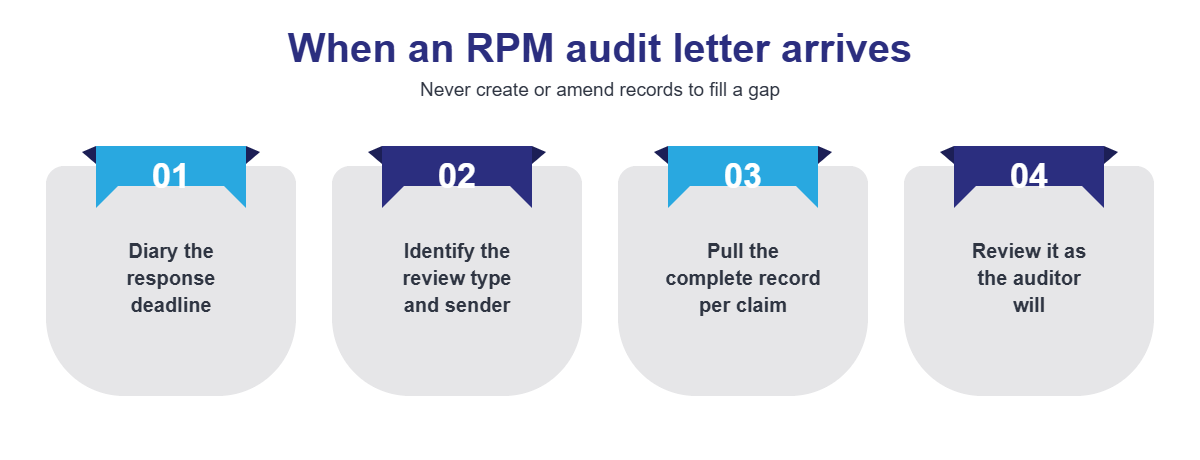
Do not ignore the deadline. Records requests carry response windows. A missed deadline is treated as a failure to support the claim, and the payment is recouped regardless of whether your documentation was adequate.
Identify what is actually being asked. A pre-payment review, a post-payment records request and an extrapolated audit have different stakes. Establish which one you are in, who sent it — MAC, RAC, UPIC or commercial payer — and the exact date range and claims at issue.
Pull the complete record for each claim, not just the billing data: consent, medical necessity documentation, device transmission logs for the specific period, treatment management notes with time recorded, and evidence of interactive communication.
Review before you send. Reading your own records as the auditor will often surfaces the gap before they find it. If the documentation does not support a claim, knowing that now shapes your response.
Never create or amend records to fill a gap. Late additions must be identifiable as such. Backdating documentation converts a billing problem into a far more serious one.
Know the appeal timeline. Medicare appeals run through redetermination, reconsideration, ALJ hearing and beyond, each with its own deadline. Missing one forfeits the stage.
Treat findings as a process signal. A single flagged claim is a claim. A pattern across months is a workflow that needs fixing before the next cycle produces the same result.
How to Scale RPM Revenue Without Increasing Administrative Burnout
Adding patients without improving process creates missed thresholds, incomplete documentation and more administrative work — the inverse of the intended result.
Model the revenue before you scale
RPM revenue is arithmetic, and the arithmetic is worth running before expanding a program. Build it per patient per month:
- Device supply — which code applies depends on qualifying transmission days, so model this at your actual adherence rate, not at the assumption that everyone clears 16 days.
- Treatment management — which code applies depends on documented minutes and interactive communication.
- Setup — one-time, per episode.
Multiply by the number of patients receiving billable services in the period, which is not the number enrolled. The gap between those two figures is where most RPM revenue projections go wrong.
Pull current rates from the CMS Physician Fee Schedule Look-Up Tool for your locality. Rates vary geographically and the national average will overstate or understate your actual reimbursement.
Three operational priorities
Improve patient engagement. Patients who understand their devices transmit more consistently — which directly determines whether the 2–15 day or 16+ day code applies, and therefore the revenue.
Connect clinical activity to billing records. Integrating platform data with clinical documentation lets staff identify eligible services without reconciling disconnected systems each month.
Track the right indicators. Claim denial rates, qualifying monitoring periods, documented management time, reimbursement trends, and the ratio of billable to enrolled patients. Together these tell you whether revenue loss comes from patient adherence, documentation gaps, or coding errors — three problems with three different fixes.
Why Professional RPM Billing Oversight Supports Sustainable Revenue
As programs expand, managing changing CPT requirements, monitoring records, claim submissions and payer follow-ups alongside clinical work becomes the constraint.
RPM billing services can support code selection, documentation compliance, insurance verification, claim submission, denial resolution and reimbursement tracking, including the 2026 coding changes.
One caution worth knowing: CMS has proposed restrictions on third-party RPM billing arrangements and on who may furnish treatment management time. Confirm that any outsourcing arrangement is structured to comply.
Protect Your RPM Revenue With Compliance-First Billing
RPM creates genuine recurring revenue, but it depends on accurate documentation, correct code selection, and consistent review.
The 2026 changes open additional reimbursement pathways and add new ways to bill incorrectly. Matching every claim to the services actually delivered is what separates the two.
Ready to strengthen your RPM billing process? Explore Steady Medical Billing’s RPM billing services.
Frequently Asked Questions
What are the billing requirements for remote patient monitoring?
Medicare RPM billing requires medically necessary monitoring, patient consent at the time services are provided, an established patient relationship, qualifying connected devices, and documentation supporting the billed services. Device transmission days and treatment management time must meet the requirements of the specific CPT code reported.
What changed for RPM billing in 2026?
Medicare added codes covering shorter monitoring and management periods, so services that previously fell below the traditional thresholds can now be reported. Device-supply billing is split between 2–15 qualifying days and 16 or more days within a 30-day period. Confirm current code descriptors against the AMA CPT 2026 code set before billing.
Can I bill both device-supply codes in the same month?
No. The 2–15 day and 16+ day device-supply codes are alternatives for the same monitoring period, not additions. Count qualifying transmission days, then report the matching code.
Can more than one practitioner bill RPM for the same patient?
No. CMS permits only one practitioner to bill remote monitoring for a patient during a 30-day period. Coordinate before enrolling a patient who may already be monitored by another practice.
How much does Medicare pay for remote patient monitoring?
Reimbursement varies by CPT code, geographic locality and applicable payment adjustments. Verify current amounts with the CMS Physician Fee Schedule Look-Up Tool.
Is remote patient monitoring covered by insurance?
Original Medicare covers eligible RPM services. Medicare Advantage, Medicaid and commercial plans may also cover them, but eligibility, reimbursement and documentation requirements vary by payer and plan — verify per payer rather than assuming Medicare rules apply.