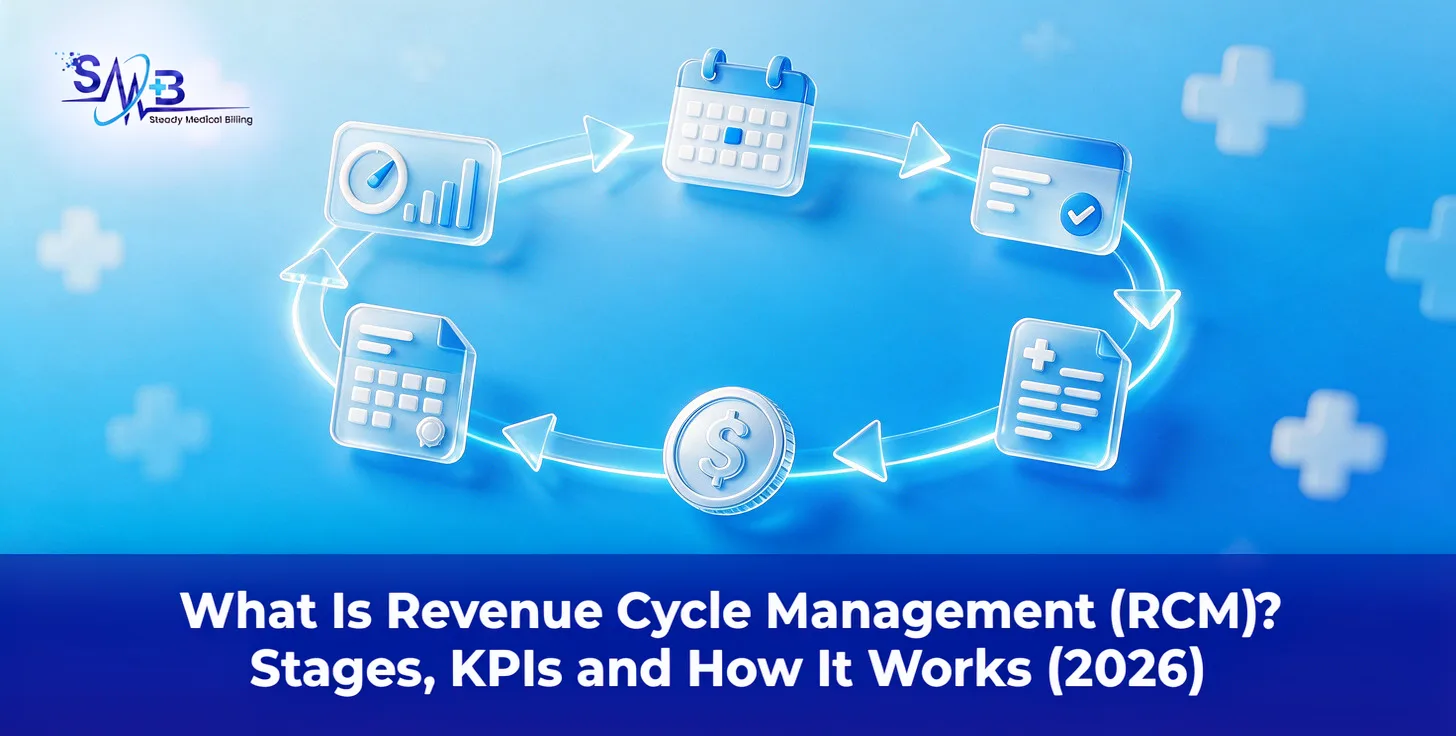
Revenue cycle management (RCM) is the process a healthcare practice uses to get paid for patient care, from the moment an appointment is booked to the moment the final balance is collected. It covers registration, insurance verification, coding, claim submission, payment posting, denial management, A/R follow-up and patient billing. Its health is measured with KPIs such as clean claim rate, denial rate, net collection rate and days in A/R.
Every visit a practice delivers becomes revenue only after it moves through a chain of administrative steps. A missed eligibility check, a wrong code or an unworked denial at any point breaks that chain, and the money either arrives late or not at all. This guide explains how revenue cycle management in healthcare works, the 10 stages of the cycle, the KPIs that show whether it is healthy, and practical ways to improve it.
Key Takeaways
- RCM is the full financial journey of a patient encounter, not just medical billing. Billing is one part of it.
- The cycle has three phases: the front end (scheduling, registration, eligibility, prior authorization), the mid-cycle (documentation, charge capture, coding) and the back end (claims, payment posting, denials, A/R and patient collections).
- Many denials trace back to registration and eligibility errors, which are cheaper to prevent than to appeal.
- Track a small set of KPIs every month: clean claim rate, initial denial rate, net collection rate, days in A/R and A/R over 90 days.
- Whether RCM is run in-house or outsourced, the same stages, controls and metrics apply.
What Is Revenue Cycle Management?
Revenue cycle management is the set of administrative and clinical processes a provider uses to capture, manage and collect revenue for the services it delivers. In healthcare, the “cycle” starts before the patient arrives, when the practice confirms who will pay for the visit, and ends when the account balance reaches zero.
Healthcare RCM is more complex than billing in most industries because the practice usually has more than one payer for a single visit. An insurer pays part of the allowed amount under a contract, and the patient owes the rest as a copay, coinsurance or deductible. Each payer has its own coverage rules, coding edits, prior authorization requirements and filing deadlines, and the practice has to satisfy all of them to be paid in full.
RCM in Medical Billing
RCM in medical billing refers to how the billing function fits inside the wider revenue cycle. Medical billing turns coded services into claims, sends them to payers and follows up on payment. Revenue cycle management adds everything that determines whether those claims will be paid: the patient’s demographics and insurance, the documentation behind each code, the payer contract, and the reporting that shows where revenue is leaking.
RCM vs Medical Billing
| Aspect | Medical billing | Revenue cycle management |
|---|---|---|
| Scope | Creating, submitting and following up on claims | The whole financial journey, from scheduling to the final patient payment |
| Starts | After the visit is coded | Before the visit, at scheduling and registration |
| Main goal | Get each claim paid | Collect all revenue owed, as quickly and cheaply as possible |
| Includes | Claim creation, submission, payment posting, follow-up | Billing plus eligibility, prior authorization, charge capture, coding, denial prevention, patient collections and analytics |
| Measured by | Claims submitted and paid | Clean claim rate, denial rate, net collection rate, days in A/R, cost to collect |
Denial management is another piece that is often confused with RCM. Our guide to denial management vs revenue cycle management explains where one ends and the other begins.
Why Revenue Cycle Management Matters
A practice can deliver excellent care and still struggle financially if its revenue cycle is weak. Strong RCM matters for four reasons:
Cash flow. Clean claims are paid in weeks. Rejected, denied or unworked claims can take months, or never be paid.
Revenue leakage. Missed charges, undercoding, underpayments, unappealed denials and claims that pass the payer’s timely filing limit are revenue the practice earned but never collects.
Patient responsibility. Deductibles, copays and coinsurance mean part of almost every visit is owed by the patient. Collecting it requires accurate estimates and clear statements, not just insurance follow-up.
Compliance. Coding, billing and patient-estimate rules (including the No Surprises Act) carry real penalties. A well-run revenue cycle builds compliance checks into each step.
Practices that manage these well usually see the effect on the bottom line. See how revenue cycle management improves practice profitability for the financial side in more detail.
The 10 Stages of the Healthcare Revenue Cycle
The revenue cycle is usually grouped into three phases. The table gives the overview, and each stage is explained below.
| Phase | Stage | What happens | Common failure |
|---|---|---|---|
| Front end | 1. Scheduling and registration | Collect demographics, insurance and consent | Wrong member ID, name or date of birth |
| Front end | 2. Eligibility and benefits verification | Confirm active coverage, copay, deductible and network status | Coverage terminated or plan changed |
| Front end | 3. Prior authorization | Obtain payer approval for services that require it | Service performed without an authorization |
| Mid-cycle | 4. Documentation and charge capture | Record services and turn them into charges | Missed or late charges |
| Mid-cycle | 5. Medical coding | Assign ICD-10-CM, CPT and HCPCS codes and modifiers | Wrong code, missing modifier, unsupported level |
| Mid-cycle | 6. Claim scrubbing and submission | Check claims against edits and send them to payers | Rejections for format or data errors |
| Back end | 7. Payment posting | Post insurance and patient payments and adjustments | Underpayments posted without review |
| Back end | 8. Denial management and appeals | Correct, resubmit or appeal denied claims | Denials written off instead of worked |
| Back end | 9. A/R follow-up | Chase unpaid claims by age and payer | Claims aging past timely filing limits |
| Back end | 10. Patient billing and collections | Bill and collect patient balances | Unclear statements and no payment options |
Front End: Before and at the Visit
1. Scheduling and registration. The revenue cycle begins when the appointment is made. Staff collect the patient’s legal name, date of birth, address, insurance card (front and back), subscriber details and any secondary coverage. Small errors here, such as a transposed member ID, are among the most common reasons claims are rejected.
2. Eligibility and benefits verification. Before the visit, the practice confirms that coverage is active on the date of service and checks the copay, deductible, coinsurance, network status and any visit limits. Most practices run electronic eligibility checks (the 270/271 transaction) and call the payer when the response is incomplete. Our guides on preventing insurance verification errors and verifying Medicare coverage walk through the process.
3. Prior authorization. Many payers require approval before imaging, procedures, specialty drugs, therapy and some referrals. The authorization number has to be on the claim, and the service has to match what was approved. When care can’t wait, some payers allow a retro authorization, but it is the exception, not a workflow.
Credentialing comes before all of this. A provider who isn’t credentialed and enrolled with a payer can’t be paid in network, however clean the claim. See what medical credentialing is and why enrollment delays stop the revenue cycle before it starts.
Mid-Cycle: Turning Care Into Charges
4. Documentation and charge capture. The provider documents the encounter, and every billable service, supply and drug is turned into a charge. Charges should be posted promptly; HFMA’s MAP Keys treat charges posted more than three days after the date of service as late charges. Missed charges are pure revenue loss. See our guide to charge entry in medical billing.
5. Medical coding. Coders translate the documentation into ICD-10-CM diagnosis codes, CPT and HCPCS procedure codes, and modifiers. The codes must be supported by the record, follow NCCI edits and match payer coverage policies. Both undercoding and overcoding cost money, through lost revenue or audit risk. Certified medical coding services reduce both.
6. Claim scrubbing and submission. The claim is built (CMS-1500 or 837P for professional services, UB-04 or 837I for facilities), checked against payer and clearinghouse edits, and submitted electronically. A clearinghouse catches format and data errors before the payer sees the claim. Learn how this step works in our medical billing clearinghouse guide and the difference between professional and institutional claims.
Back End: Getting Paid
7. Payment posting. Payments arrive on electronic remittance advice (the 835) or paper EOBs. Each payment, contractual adjustment and patient responsibility amount is posted to the account. Good posting compares what was paid with the contracted rate, so underpayments are caught instead of being adjusted off. Here’s how inaccurate payment posting distorts practice financials.
8. Denial management and appeals. When a payer denies all or part of a claim, the remittance carries claim adjustment reason codes (CARCs) and remark codes (RARCs) that explain why. Each denial should be corrected and resubmitted or appealed within the payer’s deadline, then tracked by reason and payer so the root cause can be fixed. Our guide to denial management in medical billing shows how to build that process.
9. A/R follow-up. Accounts receivable is the money owed to the practice. Unpaid claims are worked by age bucket (0-30, 31-60, 61-90, 91-120 and over 120 days) and by payer, highest dollar and oldest first, with claim status checks (the 276/277 transaction) and payer calls. Claims that age past the payer’s timely filing limit, which for Medicare is 12 months from the date of service, can no longer be paid. See what A/R is in medical billing.
10. Patient billing and collections. Once insurance has paid, the remaining balance is billed to the patient. Clear statements, online payment, payment plans and collecting copays at check-in all raise collection rates. Patient billing also has rules of its own, covered in our guide to patient balance billing rules.
Reporting closes the loop. Denial, A/R and payment data from the back end should feed back into registration, authorization and coding so the same errors aren’t repeated next month.
Revenue Cycle KPIs to Track
You can’t manage a revenue cycle you don’t measure. HFMA’s MAP Keys are the industry-standard definitions for revenue cycle KPIs. The table below shows the core metrics for a physician practice. The targets are widely used rules of thumb, not HFMA benchmarks, and results vary by specialty, payer mix and setting, so treat them as starting points.
| KPI | How to calculate it | Common target |
|---|---|---|
| Clean claim rate | Claims that pass edits with no manual intervention ÷ total claims submitted | 95% or higher |
| Initial denial rate | Claims denied on first submission ÷ total claims remitted | Under about 5-7% |
| Net collection rate | Payments, net of refunds ÷ (charges − contractual adjustments), for the same period | 96% or higher |
| Days in A/R | Total A/R ÷ average daily gross charges over the last 3 months | Under about 40 days for most outpatient practices |
| A/R over 90 days | A/R older than 90 days ÷ total A/R | Low and falling; many practices aim for under 15-20% |
| Charge lag | Average days from date of service to charge posting | Within 1-3 days |
| Point-of-service collections | Patient payments collected at or before the visit ÷ total patient payments | Rising month over month |
| Cost to collect | Total revenue cycle cost ÷ total cash collected | Falling as automation and first-pass accuracy improve |
Calculate net collection rate against the amount you were contractually owed, not gross charges, and don’t hide denial write-offs inside contractual adjustments. Otherwise a practice can look healthy on paper while denied claims are quietly written off.
For example, a practice with $100,000 in charges, $40,000 in contractual adjustments and $57,000 collected has a net collection rate of $57,000 ÷ $60,000 = 95%. The missing $3,000 is revenue it was owed and hasn’t collected yet.
Common Revenue Cycle Problems and How to Fix Them
| Problem | Typical cause | Fix |
|---|---|---|
| High rejection rate | Demographic and insurance errors at registration | Scripted intake, card scanning and real-time eligibility checks |
| Eligibility and coverage denials | Coverage not verified before the visit | Verify every visit 24-72 hours ahead and again at check-in |
| Authorization denials | No tracking of which services need approval | A payer-by-service authorization matrix and an auth log |
| Coding denials | Missing modifiers, NCCI conflicts, unsupported E/M levels | Coder education, claim scrubber edits and regular coding audits |
| Growing A/R over 90 days | No daily follow-up workflow | Work queues by age and dollar value, with payer escalation paths |
| Underpayments | Fee schedules not loaded or compared at posting | Contract variance checks on every remittance |
| Low patient collections | No estimates, confusing statements, no payment options | Estimates, collection at check-in, online pay and payment plans |
Small and independent practices feel these problems most, because a single staff absence can stop claims going out. Our guide to the top RCM challenges facing independent doctors covers them in more depth.
RCM Technology and Automation
Most revenue cycles run on four core systems:
- Practice management (PM) system: scheduling, registration, charges, claims, posting and A/R.
- Electronic health record (EHR): clinical documentation that supports every code billed.
- Clearinghouse: claim scrubbing, eligibility, claim status and remittance files.
- Reporting and analytics: dashboards for denials, A/R aging, payer performance and KPIs.
Automation is now common for eligibility checks, claim status, payment posting from 835 files and coding suggestions. It removes repetitive work, but it doesn’t replace people who understand payer rules, appeals and documentation. The best results come from automating the routine work and giving staff time for the exceptions.
How to Improve Your Revenue Cycle: 8 Steps
- Measure your baseline. Pull the KPIs above for the last three to six months, by payer and by provider.
- Fix the front end first. Tighten registration, verify eligibility before every visit and track authorizations. Front-end errors are the cheapest denials to prevent.
- Collect at the point of service. Give patients estimates and collect copays and known balances at check-in.
- Close charges daily. Reconcile the schedule against charges every day so nothing is missed or posted late.
- Audit coding regularly. Review a sample of claims per provider each quarter for coding accuracy and documentation support.
- Scrub every claim. Use clearinghouse and payer-specific edits to catch errors before submission.
- Work every denial and track root causes. Group denials by reason code and payer, fix the cause upstream, and appeal within deadlines.
- Review KPIs monthly. Share a one-page dashboard with providers and leadership and set targets for the next month.
In-House vs Outsourced RCM
Outsource when denials, A/R or staff turnover are costing more than a billing partner would; keep RCM in-house when a stable, trained team is already hitting its KPIs. Practices can run the revenue cycle with their own staff, outsource it to a billing company, or use a hybrid where front-desk tasks stay in-house and coding, claims, denials and A/R go to a partner. In-house RCM gives direct control but depends on a few people and on keeping their training current. Outsourcing adds a specialist team and coverage during staff absences, but it has to be managed with clear metrics and contract terms. Our checklist for choosing a medical billing company compares in-house and outsourced billing costs and lists the questions to ask any vendor.
RCM for Small Practices vs Hospitals
The stages are the same, but the scale and focus differ. Small practices bill professional claims, rely on a few staff for every step, and gain most from front-end accuracy, fast charge entry and steady A/R follow-up. Hospitals and health systems bill institutional claims, manage utilization review, DRG and case-mix documentation, and track additional KPIs such as discharged-not-final-billed days and cost to collect by department. Patient estimate rules also apply in both settings: under the No Surprises Act, providers must give uninsured and self-pay patients a good faith estimate of expected charges when care is scheduled at least 3 business days ahead, or when the patient asks.
Want to know where your revenue cycle is leaking? Steady Medical Billing will review your claims, denials and A/R and benchmark your KPIs, at no cost. Request your free RCM audit.
Frequently Asked Questions
What is revenue cycle management in healthcare?
Revenue cycle management (RCM) is the process healthcare providers use to get paid for patient care, from scheduling and insurance verification through coding, claim submission, payment posting, denial management, A/R follow-up and patient collections.
What is RCM in medical billing?
Revenue cycle management in medical billing is the wider process that surrounds billing. Billing creates and follows up on claims, while RCM also covers eligibility, prior authorization, charge capture, coding, denial prevention, patient collections and the reporting that shows where revenue is lost.
What are the stages of the revenue cycle?
The 10 stages are scheduling and registration, eligibility and benefits verification, prior authorization, documentation and charge capture, medical coding, claim scrubbing and submission, payment posting, denial management and appeals, A/R follow-up, and patient billing and collections.
What is the difference between RCM and medical billing?
Medical billing is one part of revenue cycle management. Billing starts after the visit is coded and focuses on getting claims paid. RCM starts at scheduling and covers every step that affects whether, how much and how fast the practice is paid.
What are the most important RCM KPIs?
The core KPIs are clean claim rate, initial denial rate, net collection rate, days in A/R and the share of A/R over 90 days. Many practices also track charge lag, point-of-service collections and cost to collect.
How long does the revenue cycle take?
Medicare pays clean electronic claims no earlier than 14 days after receipt and generally within 30 days. Commercial payers vary by contract and state prompt-pay rules. Denials, appeals and patient balances extend the cycle, which is why many practices aim to keep average days in A/R under about 40.
Should a practice outsource revenue cycle management?
Outsource when denials, A/R or staff turnover cost more than a billing partner would, and keep RCM in-house when a stable, trained team is already hitting its KPIs. Compare the full in-house cost with a vendor’s fee and with how much more of what you are owed each option collects.